

TOKUSATSU TRADITION, AND WHERE TO START YOUR RIDER KICK-OFF
added sep.3.25
updated sep.19.26
difficulty rating ●○○○
it's come up a lot in passing or in rambling diatribes about color theory, but in case you missed it, i happen to be a pretty big fan of Kamen Rider. it's an intensely varied franchise that you can approach from a ton of angles, and despite its relative obscurity outside of Japan, it's so intensely popular there that learning about it feels like kind of a Rosetta Stone for parsing all sorts of superheroic tropes in your favorite anime and manga.
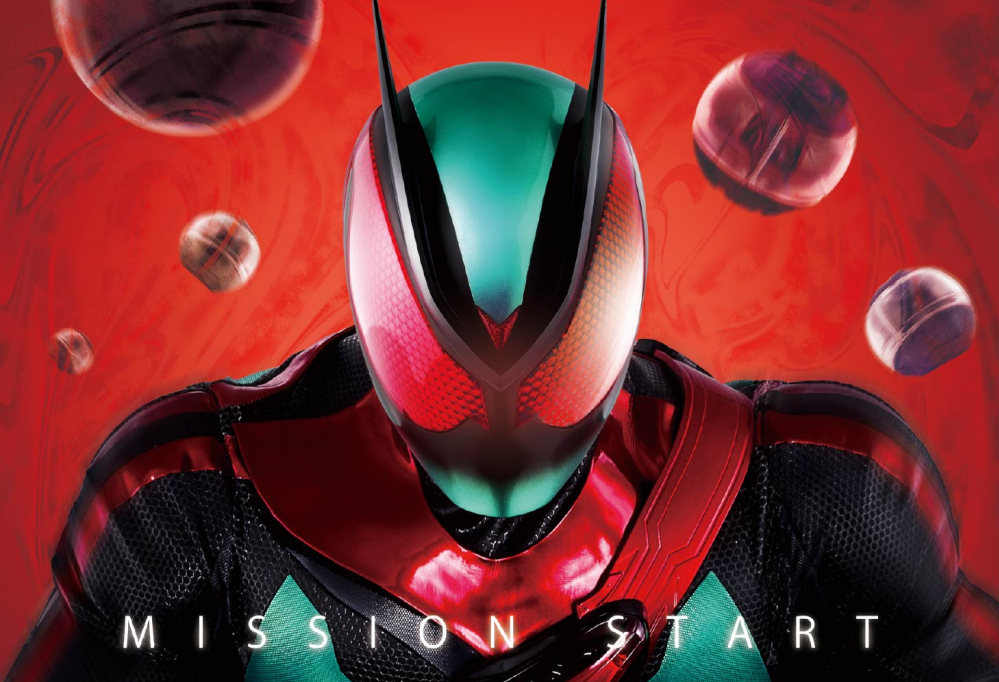
thankfully, despite its long legacy, every year represents a new chance to get in on the ground floor. new seasons of Kamen Rider debut annually like clockwork as we head into autumn, and throughout the 2020s, it's gotten more accessible for international fans than ever before, even with some bumps along that road. my own personal experience with Kamen Rider started from afar, appreciating its suit design and following each new release only through the lens of waiting for the next toy to drop. now that i've watched several seasons for myself - and been able to see Toei trying to expand the franchise's reach - i hope that more people can give these shows a shot.
undeniably, though, Kamen Rider can be a lot to process if you haven't been inoculating yourself to its over-the-top theatrics for years. i feel like culturally, we're in the midst of a big pendulum swing towards color and camp breathing life back into superhero media, with films like James Gunn's Superman, but even that is still an 'all audiences'-type of movie, tapping into some very real and very heavy world events with the same confidence as including characters like Krypto the Superdog. Superman does not draw his power from collectible toys spouting off 15-second jingles, and the medium of his world isn't a weekly television show meant to sell toys to Japanese pre-teens. in the most sincere, least gatekeep-y way possible, i wouldn't blame anyone who walks out of a DCU movie saying "i love campy capeshit" to still bounce off of Kamen Rider's intensity.
so, consider this a crash course for the Rider-curious. i can't necessarily make you someone who's going to like Kamen Rider, or impart full encyclopedic knowledge of every show's ins and outs, but what i can do is try to give you a basic framework of the franchise's history and production, some idiosyncracies that might not be immediately obvious if you're just hopping into fan discussion for the first time, and a few personal impressions of seasons i've seen.
WHAT IS KAMEN RIDER? LIKE, WHAT'S IT ABOUT?
Kamen Rider is, on a big picture basis, a long-running franchise of tokusatsu series, originated by prolific mangaka Shotaro Ishinomori in 1971, produced by television supergiant Toei in close partnership with toymakers at Bandai. having been running on-and-off for over fifty years, the shows feature costumed superheroes, classic 'rubber suit' monsters, and a plethora of pyrotechnics, wire works, and other special effects to create larger-than-life fight sequences.
to an outside observer, it might seem like Kamen Rider is a title so broad as to be meaningless. each year brings a new season with its own largely self-contained premise; new cast, new worldbuilding, new suits, new everything, with a few loose patterns imposed by the franchise's needs as a toyline. you can hop into basically any season of Kamen Rider and watch it on its own merits without paying any thought to what came before or after, aside from some anniversary milestones and maybe a handful of standalone crossover specials.
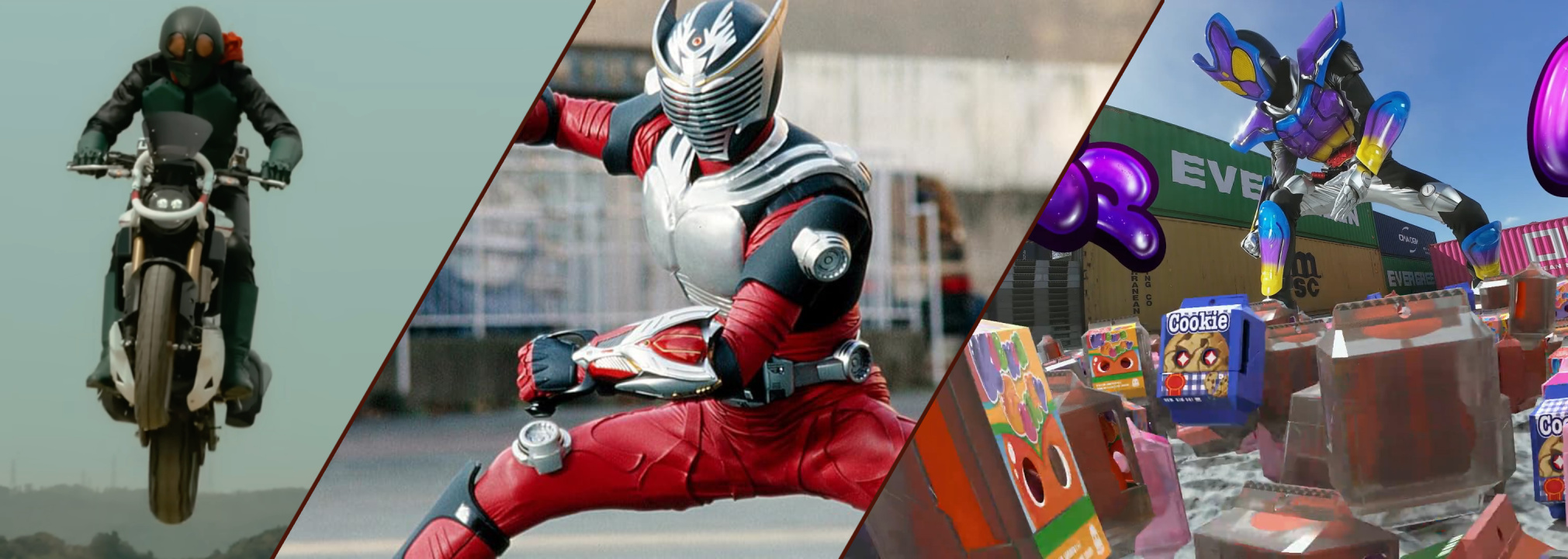
much like fellow Japanese icon/Bandai flagship/chronic re-interpreter Mobile Suit Gundam, though, even if new iterations might vary wildly, there's a core thematic underpinning dating all the way back to Kamen Rider's roots that's stuck with the show to this day. Shotaro Ishinomori was fascinated with the idea of a hero defined by tragic irony, someone who had something taken from them and had to use power granted through evil to protect the innocent. the original Kamen Rider, Takeshi Hongo, was kidnapped by fascist scientists and turned into a cyborg, stealing away his life as a promising young student while ultimately creating their own downfall. even now in the 2020s, this same foundational ideal is rethought and remixed for every new season of Kamen Rider, and while different seasons might emphasize it to different degrees, "Kamen Riders use the same power as their enemies to fight for justice" is generally applicable to any given version.
of course, there's also just the name itself. "Kamen" literally translates to "masked", and "Rider" is increasingly a bit of an oddity, carried over through years of tradition. the original Kamen Rider was an avid motorcyclist, with his iconic red-and-white Cyclone proving to be the perfect way to generate enough wind power to activate his transformation. the fact that lead actor Hiroshi Fujioka broke his leg doing his own stunts within the first dozen episodes and had to pass the mantle off to Rider #2 for almost thirty episodes was probably a bad omen for how long motorcycles could remain a core pillar of the franchise, in hindsight. Japanese road safety laws mean that nowadays, the bike is largely a formality reserved for the first handful of episodes, no matter how elaborate the workarounds get, including
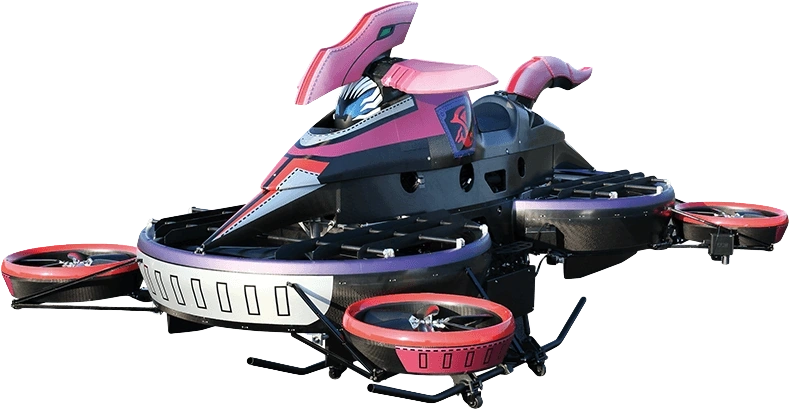 investing in a real-world cutting-edge hoverbike.
in short, don't worry about it too much.
investing in a real-world cutting-edge hoverbike.
in short, don't worry about it too much.
HOW DOES THE WHOLE TOYLINE THING FACTOR IN?
over the years, Kamen Rider has proven to be an incredibly lucrative way to sell lots of toys, and modern Rider is essentially built in tandem around its toyline in such a way where you can identify patterns year-to-year; patterns which, in turn, inform the way fans talk about and compare seasons.
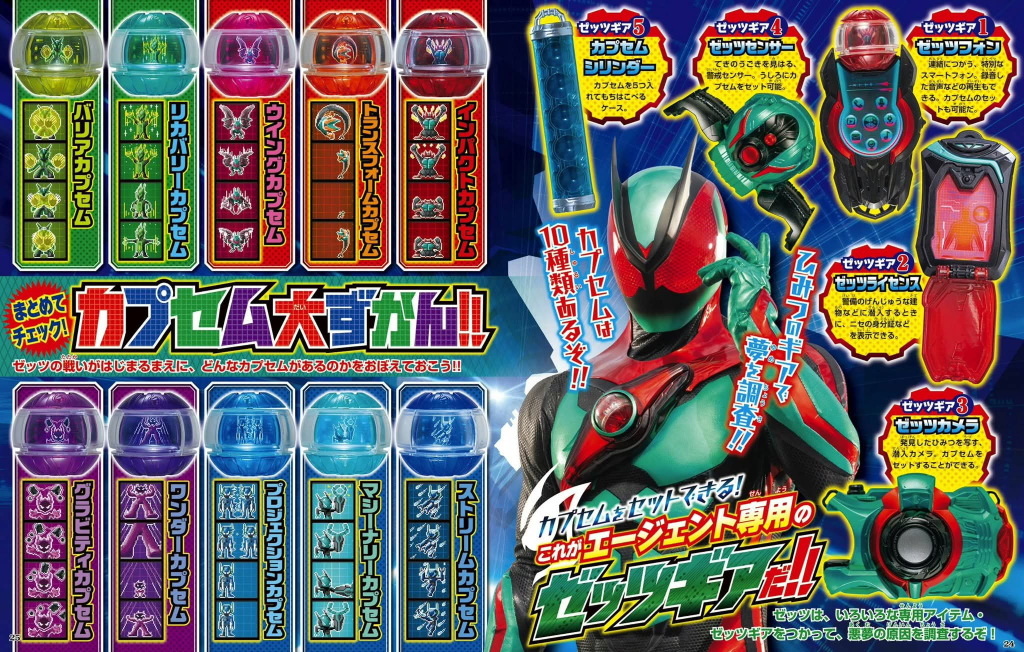
a new season of Kamen Rider generally starts around September, and right off the bat, the toys are often one of our first glimpses at what we're in store for, debuting a month or two ahead of the actual television series. this initial rollout will include things like the new protagonist's transformation equipment (almost always a belt, although some recent Riders are mixing things up by wearing theirs cross-body style), some weaponry, a bike that's compatible with new action figures, and since around the 2010s, the all-important collectible items that work with all these other toys to produce all sorts of lights and sounds. these collectibles can be straightforward, like trading cards or gashapon-style capsules, or as uniquely themed as miniature monsters shaped like snack bags.
one reason i want to put such a fine point on the toyline side of Kamen Rider - aside from the fact that you could collect the gear from the show, if you're willing to deal with importing everything from Japan - is that being savvy to how the pacing of new toys affects the pacing of the narrative is kind of taken for granted by long-time fans. you might see things like "Q1 upgrade" thrown around, and while it's not hard to connect that to the context of a character receiving a power-up in the show, the fact that it almost always happens within a specific range of dates every year is predicated on the idea that the toys are coming out at a predictable, carefully tuned cadence. even the 'Q1' in there is referring to fiscal quarters, partially as an artifact of the days when entire toy catalogs would leak every three months and often provide our first look at a new season.
once you spot this pattern - a Q1 blowout ending with an upgrade around December, an additional Rider arriving with their own gear in Q2, a final form debuting in summer as part of Q3, movie tie-in toys filling out Q4 as the show winds down to make way for a new cycle - you'll start to notice how it provides a framework for the narrative of any given season. different seasons might handle these elements more-or-less gracefully depending on the writer and how well-equipped they are to plan things out with all aspects of the show's production, but there's a remarkable consistency that then becomes the standard language die-hard fans use to contextualize the show.
I SAW SOMEONE TALKING ABOUT "SHOWA" AND "HEISEI", WHAT'S UP WITH THAT?
you mostly don't need to worry about this, but it does come up just often enough that i should probably explain it? it basically just means 'old' and 'new, but in the way things from 2007 are still new'.
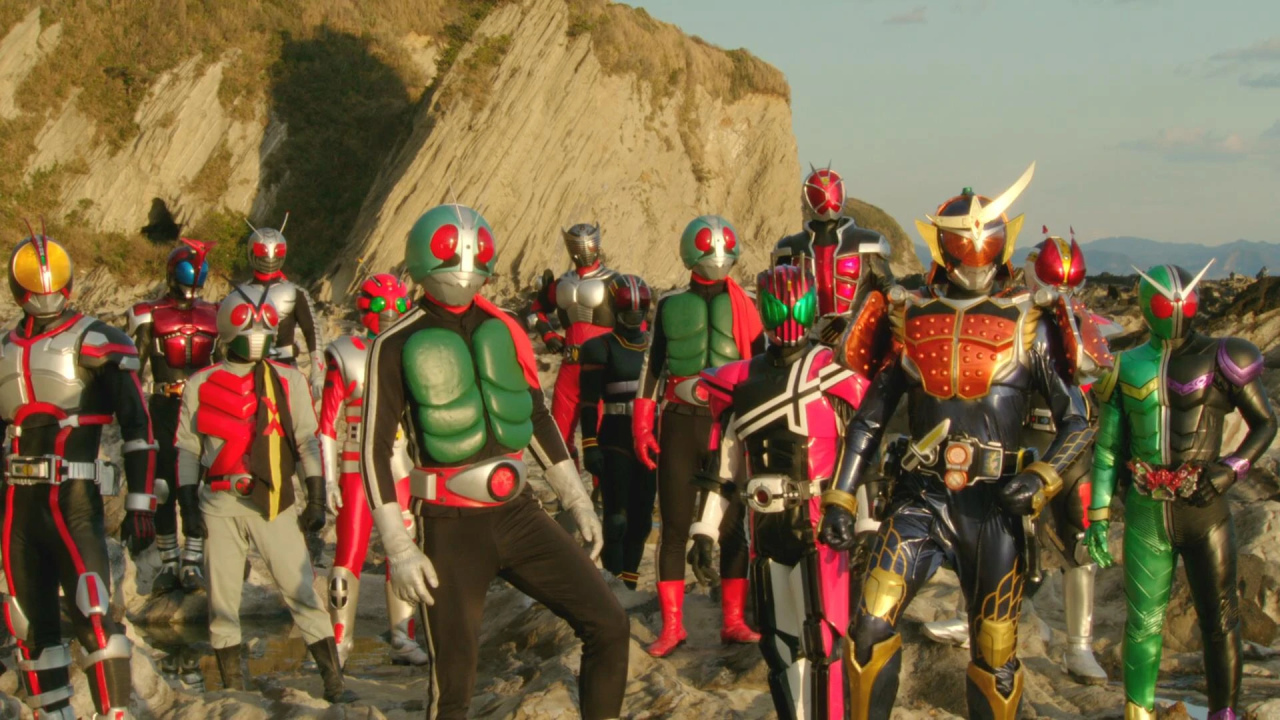
like a lot of other tokusatsu franchises such as Godzilla, Japan's imperial eras often get used as shorthand by both fans and creators to draw dividing lines between different eras of production. Kamen Rider started in the Showa era, made a comeback in the Heisei era, and has been on the air ever since, rolling directly into the current Reiwa era. as you can probably guess by me dedicating any amount of time to explaining this, it's not exactly that simple, though.
first of all, in both cases where the era changed over, Kamen Rider was still actively on the air as it happened. the literal, actually-recognized-by-the-government Heisei era kicked in about ten episodes into Black RX, the last televised Rider of the 1980s. meanwhile, in 2019, everyone knew the emperor was stepping down in advance, so Kamen Rider Zi-O got to use the start of the Reiwa era as a metatextual element to its time travel anniversary shenanigans.
more importantly for the matter of shorthand, though, when Kamen Rider evokes the Showa era, it actually means 'from 1971 to about 1994, five years deep into the Heisei era'. with the television series in cancellation limbo for the third time, Shotaro Ishinomori instead helped develop future concepts as one-off movies, with Kamen Rider J being the last of the three to release before Ishinomori passed away in 1998. as a result, the line gets nudged over to include the three theatrical riders of the 1990s, and instead serves as a distinction between Shotaro Ishinomori's creations and later adaptations.
Heisei and Reiwa proved to be a much cleaner, less dramatic split, with Kamen Rider having stayed on the air consectutively the whole way; 25 years straight, as of this writing. all the same people still produce the show, so the distinction is really just technical. you might see people bring up 'Phase 2' or 'Neo'-Heisei, referring to everything between W and Zi-O, but as far as i can tell, that's just a fan-created subcategory that's caught on. those shows do happen to cover the period where you really see collectible devices start taking off as a core component that spans the entire toyline, so it's not an entirely useless term. you're just less likely to see that level of granularity when it comes to things like big crossovers or the usually-toy-exclusive 'Legend Rider' items that pay homage to past seasons.
WHERE CAN I WATCH KAMEN RIDER, AND WHY IS IT SO GODDAMN HARD?
this is where we start getting into why Kamen Rider has really struggled to find a foothold outside of Japan! it's only been over the last few years that Toei has made any major moves to bring Kamen Rider to an international audience, and even those moves have often been at the mercy of needlessly complicated licensing deals. this is a situation that still seems to change from year to year, but i can at least try to break down some of the major avenues of release, so you know where to keep an eye on.
if you want to watch old-school Showa era Kamen Rider, the retro anime juggernauts over at Discotek Media seem to have secured a long-term partnership with Toei to bring those classic seasons overseas. everything between 1973's Kamen Rider V3 and 1988's Kamen Rider Black RX falls under their purview, and while i haven't picked any of these releases up for myself, they seem like incredibly well-rounded packages, with solid film transfers and bonus materials.
for quite a while, it seemed liked Shout! Factory might end up being Toei's go-to American distributor, having already been grandfathered into a tenuous partnership through Power Rangers and its original Super Sentai counterpart. there wasn't much rhyme or reason to their release schedule, but there was a time when Shout! held the rights for the original 1971 Kamen Rider, scattered fan-favorites across the Heisei and Reiwa catalog, and eventually, the simulcast rights for Kamen Rider Zeztz, broadcast to YouTube within hours of its debut on Japanese television. unfortunately, many of these rights have expired with no notice, and it seems as if Shout! Factory's new parent company isn't interested in maintaining a working relationship with Toei. their releases all seem perfectly servicable, but it's worth keeping in mind that they're also going to become increasingly hard to track down as they fall out of print.
that then leads us to the matter of Toei doing the damn thing themselves. in Japan, they have a few different solid partnerships with various streaming platforms, and one of their own in the form of Toei Tokusatsu Fan Club, which hosts their entire broadcast catalog and then some. for western audiences, they have something... kind of named in a similar way, but it's just a YouTube channel they sometimes forget about...?
Toei Tokusatsu World Official has always seemed weird, despite being the most directly managed distribution channel i'm covering. for the longest time, its catalog primarily consisted of dormant classics from the 20th century, with shows like Space Sherriff Gavan and Kaiketsu Zubat. when Kamen Rider finally showed up, it was only the first two episodes of each series, with translations subsidized by the Japanese government. TTWO has always felt like kind of an afterthought, suffering from things like highly compressed video and sloppy subtitle sync, and Toei didn't help that perception by leaving the channel dormant for nearly half a decade.
this channel's story refuses to end, though! with renewed interest in making Kamen Rider work internationally and a dwindling list of potential licensees, Toei Tokusatsu World Official has sprung from the grave, filling a critical niche in Toei's strategy until they figure out a better solution. with 'prestige' anniversary projects being eyed for potential western releases, TTWO has broadcast past seasons such as Agito and Kabuto to get us up to speed. it's also set to host the full backlog of Zeztz post-licensing collapse, and it's even become the de facto home for 2026's Kamen Rider My-Th.
on the one hand, it's nice to see Toei stepping in and working very directly to make Kamen Rider more accessible. on the other hand, their strategy feels extremely backwards, whether that's because of domestic broadcasting arrangements or just old-fashioned stubborn protectiveness. when i say they broadcast seasons of Kamen Rider on YouTube, i mean it in a very traditional sense; episodes premiere at a set time and stay uploaded for maybe a month before being removed. this was almost the case for Zeztz's first run as well, which makes this all the more annoying, because Shout! Factory managed to negotiate a way more sensible deal that allowed for the show to remain available all year, and Toei seems to have learned very little from that.
with the announcement that they would be taking simulcasting (or, rather, two-days-after-Japan-casting) into their own hands, Toei added that "We are also preparing a streaming platform for [western territories]". it doesn't seem especially clear what that entails. if they're thinking about launching their own subscription service internationally, i feel like Kamen Rider is way too niche to carry that in a market where people are tired of the big streaming platforms. if they're talking about partnering with an existing distributor - say, Amazon Prime, who they've worked with before on a handful of miniseries - then the statement seems like the most vague, roundabout way of signalling that. watch this space for whatever they end up actually doing.
as it stands, there are more ways than ever to watch officially sanctioned Kamen Rider internationally. we're still in the throes of some growing pains, but there's been several seasons released on Blu-Ray and with some heavy, constantly shifting asterisks, you can pretty reliably watch the latest seasons on YouTube alongside their broadcast run in Japan, so long as you're willing to start right away and keep up on a regular basis. this is all just coming from my experience here in North America, too; TokuSato is on a pretty generational run when it comes to delivering tokusatsu with Portuguese and Spanish subtitles.
with all that broken down, it's also worth mentioning that fansubs exist. fansubs exist! they're out there! it's a long and storied artform! the people who've been doing it the best for the longest have always been very clear about their willingness to back off any time Toei wants to step up and sell Kamen Rider directly to international audiences, and they've generally followed through on that promise where relevant. i'll just leave it at that, for this website's sake. fansubs sure do exist. sometimes they even do all sorts of wild text rendering magic to make the belt jingles pop. they sure are out there, somewhere.
there's plenty of other weird little franchise tidbits i could dive into all day, but i think this seems like a good enough place to call it. hopefully this gives you some sense of what Kamen Rider's all about, the unique circumstances of its production, and maybe it can help chip away at some nerd talk that might seem a little impenetrable if you're just jumping in for the first time.
now comes the fun part, where i get to step out of informational mode and get all opinionated! as someone who's now seen multiple seasons of Kamen Rider, i want to give each one i've watched its own time to shine, and go over why you might want to check them out for yourself. basic beginner plot run-down, lay out some of that year's toyetic fun factor and how it might influence the design work and narrative, and make my own case for what makes it stand out from the rest. sound good? good!
KAMEN RIDER DEN-O
2007 - 2008THE BACK-OF-THE-BOX BEATS
Ryotaro Nogami, the world's unluckiest guy, discovers a mysterious train pass that puts him onboard the time-traveing DenLiner. the wish-granting Imagin are tampering with the past, but a few key defectors help Ryotaro become Kamen Rider Den-O, overriding his meek personality with their own quirks and ticks, whether that means turning him into a violent punk or a suave charmer. as they begin to form unlikely friendships and protect people's cherished memories, the arrival of new interlopers throughout the flow of history reveals deeper machinations that hit far closer to home for Ryotaro.
THE NEW TOYS
of the seasons i'll be going over here, Den-O is by far the least toyetic; it was still a few years out from those major collectible devices that plug and play with every part of a Rider's equipment. that's not to say that it doesn't have its own merchandise to push, of course. each of Den-O's Imagin allies grants a unique form, loosely themed around Japanese folklore, with its own configuration of the modular DenGasher weapon. the real thing you can tell the show really wants you to buy, though, is the DenLiner itself. while it mostly serves as a home base for the Imagin, every once in a while you'll see it start deploying increasingly absurd weaponry in massive CGI battles with foes too big for Den-O to handle alone, and the debut of new Riders and upgrades often means a new addition to the train set.
WHY WATCH THIS ONE?
what Den-O lacks in dense narrative, it makes up for five times over with character. it's not hard at all to see why this show in particular saw such an extended impact on Kamen Rider, both in a literal sense with its years of follow-up movies and by way of becoming sort of a template for future Rider casts. it's also not hard to see why its lead actor, Takeru Satoh, became such an astonishingly big star that it's hard to even book him for a return anymore, as he effortlessly layers the Imagin's larger-than-life personalities onto his own performance at the drop of a hat. Den-O can feel a little directionless as you wait for the story to kick into high gear, but when it wants to hit hard, it can go to some pretty surprising lengths to twist the knife and make you feel for the characters. if you're looking for a funny, over-the-top show with a sort of gag manga appeal to its ensemble cast, and you don't mind realizing you're starting to care too much about these dudes' emotions halfway in, check out Kamen Rider Den-O.
KAMEN RIDER OOO
2010 - 2011THE BACK-OF-THE-BOX BEATS
ancient mummies driven by sheer desire awaken in the modern world and quickly resume their business of exploiting humanity. one of their own, Ankh, ends up in an strained partnership with Eiji Hino, a kind-hearted and selfless wanderer who takes on the mantle of Kamen Rider OOO. entangled with the grudges between Ankh's fellow Greeed, the previous life of his new human host, and the enigmatic Kougami Foundation which seeks to harness the power of desire for themselves, Eiji and Ankh find themselves amidst a battle between the heights of human ambition and the lows of apocalyptic nihilism.
THE NEW TOYS
it's all about the Medals. using matching sets of animal-themed coins, Kamen Rider OOO can mix-and-match his head, torso, and legs, hotswapping between chimeric suits on the fly or going all-in on a powerful full combo. the imagery of coins in a season all about greed and ambition doesn't go underutilized either, and winds up dovetailing into the toyline nicely; OOO himself basically only has the powers of his Driver to work with, so the Kougami Foundation provides the yearly staples, such as a bike that doubles as a vending machine to store helpful 'Candroids' and a sword that loads up Medals like quarters in an arcade machine.
WHY WATCH THIS ONE?
out of the seasons of Kamen Rider i've watched, OOO is the one i would most unambiguously describe as good television without many qualifiers beyond needing to open your heart to the campy appeal of tokusatsu. it does an exceptionally good job of balancing 'monster of the week' plots with a big-picture narrative that's constantly moving forward, with rivalries and alliances always feeling just fluid enough to keep you wondering what'll happen next. i would also say it feels the most thematically well-rounded, as a story and as a piece of media that's dealing with the tropes of the genre. its toyetic qualities blend seamlessly into its narrative needs, and even the strange choice of a ska-influenced soundtrack works for setting a vivid mood.
most of all, though, its core themes about unchecked ambition, the isolation of depression, and how one balances their big dreams with their capacity to inflect real change upon the world have all stuck with me deeply. it also does all this without losing sight of how silly Kamen Rider can get, with many of its most fascinating characters also being the funniest; this is a show that made me say "as far as he’s concerned, he has always been The Dinosaur Man in every way that philosophically matters" with full emotional investment. i think if you're already primed to love, say, Spider-Man - particularly interpretations that lean into how a hero beyond ordinary human limits must confront the ways in which they're still very much human - Kamen Rider OOO is the show for you.
it's also like, REALLY good if you're a fujoshi. Kamen Rider always has primarily male casts, because it's a show made to sell toys for boys and Bandai are cowards, so it's never difficult to find a pair you want to imagine kissing, but it's really front-and-center in OOO. primo enemies to lovers yaoi.
KAMEN RIDER FOURZE
2011 - 2012THE BACK-OF-THE-BOX BEATS
Gentaro Kisaragi is determined to spend his high school days befriending the entire school, but it won't be that easy with misguided and misunderstood students using Astroswitches to transform into monstrous Zodiarts. as Gentaro assembles an unlikely band of buddies and starts the Kamen Rider Club out of an abandoned lunar base, they do their best to solve students' problems and keep Amanogawa High safe, not realizing that the school staff themselves are orchestrating the Zodiarts crisis to serve their own mysterious ends.
THE NEW TOYS
if the rocket-shaped helmet didn't tip you off, Fourze is definitely 'the astronaut season'. the collectible gadgets of the year are the Astroswitches, which, more than any other Rider toy, are harder to describe as anything other than 'little gizmos'. they're doohickeys. they're thingamajigs. i guess in a more modern sense, they're kind of fidget toys? to tie into the milestone of 40 years of Kamen Rider ('four-zero', get it?), Fourze can plug four of these switches into his belt at once and activate various attachment modules. each slot has a shape, each shape is associated with one of Fourze's four limbs, and there's 40 Astroswitches total, making for a wildly varied arsenal with everything from a leg-mounted drill to a grappling winch.
WHY WATCH THIS ONE?
maybe i'm just saying this because Fourze was the first season of Kamen Rider i finally sat down and watched, but i think it's a solid entry point for the franchise. its take on the classic good-and-evil duality takes a bit of a backseat, but its big, bold, feel-good energy is no less valid than the tortured heroes who came before and after, and its very intentional mix of Japanese and American high school story tropes makes it easy to hop right in and understand the framework of these characters' friendships. especially once the series's secondary Rider arrives, the show does a good job of expanding on its dynamics and doling out memorable love-to-hate villains who's extended presence leaves a lasting impression. it's got its moments of emotional catharsis throughout, but if you're looking for an easy-going watch that embodies the weekend morning feelings tokusatsu might call to mind, Kamen Rider Fourze is a great place to start.
KAMEN RIDER GAIM
2013 - 2014THE BACK-OF-THE-BOX BEATS
in the company town of Zawame City, the youth are enraptured with the underground culture of the Beat Riders, who mix breakdancing with monster-summoning "Inves Battles" to claim turf acrosss the city. little do they know that the Inves and the Lockseeds that summon them are all part of an interdimensional breach into the forest of Helheim. as the Yggdrasill Corporation studies the rift and grants unsuspecting citizens the ability to transform into "Armored Riders", Kouta Kazuraba must balance a full-on war between the Beat Riders with chasing after the nefarious truth behind his new powers and the nature of Helheim.
THE NEW TOYS
there's like, three different layers to what Kamen Rider Gaim is doing from a design standpoint, and they're all pretty in-your-face. padlock-shaped fruits allow regular folks to open interdimensional "cracks" (they're zippers, for some reason) that summon monsters, and when 'sliced open' with a Sengoku Driver, grant fruit-themed armor to the show's cavalcade of Riders. underneath the surface of these botanical motifs - as in, literally the base suit underneath the armor - Gaim also revolves around the idea of war. marketed as a "Rider sengoku jidai", the show's plot will occasionally evoke some classic feudalism, and its many Riders have a loose 'history's greatest warriors' thing going on. most of the primary cast shares the same model of Driver, but a faceplate plugged into the side will trigger different fanfares, and you can identify some different sub-types shared between Riders; Gaim and Zangetsu both resemble samurai, while Baron and his vassal Gridon have a more European-influenced knightly aesthetic.
WHY WATCH THIS ONE?
there's
 a low-key infamous post from the age of Tumblr confession blogs about how Gaim should air on HBO.
while it's largely clowned on for representing a complete lack of perspective about Kamen Rider's target audience, and the innate absurdity of the fruit samurai season being compared to The Sopranos, i do see why Gaim of all seasons would be the one that people latch onto in that way, even if it's an incredibly shallow assessment. more than any other season i've watched, it lays the innate tragic irony of Kamen Rider on incredibly thick, no doubt thanks to its head writer Gen Urobuchi, who you might recognize better as the writer behind Madoka Magica. characters joyously join in on the Beat Riders' petty turf war, only to quickly begin discovering that the situation was bad all along and only getting worse. it's a show that's exceedingly blunt and straightforward about its themes, but they're interesting themes to deal with; does absolute power corrupt absolutely? does might make right? in what ways does the next generation perpetuate the cycle of war, particularly when the adults pulling the strings are themselves far more childish than they'd care to admit?
a low-key infamous post from the age of Tumblr confession blogs about how Gaim should air on HBO.
while it's largely clowned on for representing a complete lack of perspective about Kamen Rider's target audience, and the innate absurdity of the fruit samurai season being compared to The Sopranos, i do see why Gaim of all seasons would be the one that people latch onto in that way, even if it's an incredibly shallow assessment. more than any other season i've watched, it lays the innate tragic irony of Kamen Rider on incredibly thick, no doubt thanks to its head writer Gen Urobuchi, who you might recognize better as the writer behind Madoka Magica. characters joyously join in on the Beat Riders' petty turf war, only to quickly begin discovering that the situation was bad all along and only getting worse. it's a show that's exceedingly blunt and straightforward about its themes, but they're interesting themes to deal with; does absolute power corrupt absolutely? does might make right? in what ways does the next generation perpetuate the cycle of war, particularly when the adults pulling the strings are themselves far more childish than they'd care to admit?
as it progresses, Gaim does stumble over itself with biblical allegories, and its few female characters have a jarring lack of agency even by the relatively low 'sell toys to boys' standards of Kamen Rider. even as it got messy, though, i found myself really hooked on its characters and their intricate web of dynamics. when Gaim's firing on all cylinders, it's using the toyetic appeal of a mecha-fruit juicer that yells "SODA..." as a diegetic element of dissonance, and keeping you on the edge of your seat with a constant sense of narrative momentum. the fruits of its labor are an acquired taste, and i wouldn't blame anyone for finding some of it too bitter to swallow, but i think there's a lot to love in it.
KAMEN RIDER DRIVE
2014 - 2015THE BACK-OF-THE-BOX BEATS
after accidentally injuring a fellow officer during the time-slowing Global Freeze, Shinnosuke Tomari found himself in a deep slump, until an unlikely benefactor entrusted him with the keys to the supercar Tridoron. when the mechanical perpetrators resurface with a plan to permanently bring time to a standstill, Shinnosuke finds himself on the case from two different angles. as an officer, he works with the Special Investigation Unit to track the 108 Roidmudes and solve their crimes. unbeknowst to all but a few, he's also the city's protector, Kamen Rider Drive, armed with the sage advice of his talking belt and the high-speed power of Shift Cars. with each new case, Shinnosuke and his team piece together the messy truth behind their mission, discovering unlikely allies and enemies alike as they chase the means and motives behind the Roidmudes and their creation.
THE NEW TOYS
Drive is the first Rider to skip the bike and go straight for a transforming car, and this season goes all-in on that theming. the main collectibles here are the Shift Cars, highly stylized little automobiles which, in the show, act as sentient little helpers who can 'speak' in adorable little horn honks. each Shift Car can swap the tires on Drive's suit out, granting him abilities and equipment such as cages, shuriken, or a chest-bisecting portal that lets him split his body. as the series progresses, the arsenal expands with vehicle-shaped weaponry, the arrival of new Riders who use their own set of motorcycle-themed equipment, and eventually, my beloved Shingou-Ax, a massive bladed crosswalk sign that asks you to "WAIT FOR IT!" before launching into a finishing move. Kamen Rider Drive is full of some of the most bluntly themed and clearly toyetic equipment i've ever seen, and they somehow make it work in the show's favor.
WHY WATCH THIS ONE?
Drive is another season i would highly recommend as a good place to start with Kamen Rider. given how much it focuses on "woah, a car instead of a bike", you might think it's a big departure, but it actually evokes a ton of the foundational tropes of the franchise, and even lays them out clearly in the text while also putting its own spin on them. i think it hits a real sweet spot in terms of its ensemble cast, with even its goofiest characters getting plenty of exploration and highlights. i would especially shout out its antagonists as being some of my favorites across the whole franchise; it's easy to rattle off faux-deep observations about villains thinking of themselves as the heroes of their own stories, but the Roidmudes' leader, Heart, really sells that kind of portrayal, and the show very smartly keeps doubling down on what makes him so interesting as it approaches its ending.
if there is any sort of big caveat i'd put on this season, it's that it is the cop one. i think for the most part, it does a good job following in a long tradition of procedurals that are ostensibly set in a law enforcement agency but instead focus on larger-than-life monster of the week plots, too outlandish to nitpick the deeper politics at play. you do get a few moments of characters talking about their honor and duty as police officers, though, and i can't blame you at all if that grates on you a bit.
KAMEN RIDER ZEZTZ
2025 - 2026THE BACK-OF-THE-BOX BEATS
in his waking life, Baku Yorozu is an average guy, striving to help people even when it always seems to put him in harm's way. in his dreams, he's an invincible secret agent, working for the mysterious organization CODE. when the line between these worlds starts to blur, Baku is brought into the fold as a real agent, transforming into Kamen Rider Zeztz to infiltrate and eliminate peoples' bad dreams. as rogue agents steer the Nightmare crisis from afar, it becomes clear that not everything is what it seems, and no assumption can be trusted. to make his dream come true, Baku will have to put his faith in his own power and beliefs amidst a shadowy world of spies and subterfuge.
THE NEW TOYS
Kamen Rider Zeztz is something of a back-to-basics season when it comes to its merch, putting a lot of emphasis on its eye-catching reinterpretation of Rider tradition. without a waist belt in sight, Zeztz pairs his chest-mounted Driver with Capsems, capsules containing a variety of dream-world powers such as shapeshifting, healing, and flight. each Capsem has a rotating core with a zoetrope-style animation, and their powers can be tapped into even before Zeztz transforms by spinning them against things. the Capsems also fuel an array of spy gadgets, whether it's a motion detector on spider legs or a two-in-one fake ID and scanning lens. all things considered, it's actually a pretty understated toyline by 21st century Rider standards.
WHY WATCH THIS ONE?
we've come full circle! the first simulcasted season of Kamen Rider i initally wrote this whole article to tie into has wrapped up, and as a complete work, i can assess it against other entries in the franchise. the unfortunate thing is... i kind of think Kamen Rider Zeztz sucks!
i don't want to editorialize too hard, but i'll be blunt and say that, as of its ending, it's easily my least favorite season of Kamen Rider. my first impression was that 'secret agents' and 'dreams' might be too broad to form a solid thematic foundation, and i feel like those worries bore out. Zeztz seems like a show that wants you to care a lot about its plot and lore, but its story is repetitive and sluggish, often clearing the playing field only to then spin its wheels and make the whole endeavor feel like a waste of time. the details of its setting, much like a dream, tend to be unclear and inconsistent, making things annoying to keep track of. i could get over all that if it had some interesting message as a backbone, or if it had strong character writing to fall back on, but it doesn't. Zeztz never quite makes the most of its supporting cast, and its protagonists are tossed between an exhausting barrage of twists for so long that i feel like i barely know them beyond their canned platitudes.
it's not all doom and gloom, though. yes, Zeztz underutilizes its cast, but i only cared enough to want more because a lot of these characters did leave a good first impression. these actors are doing their damndest to sell some really rough scripts, and in the brief moments where this show will shut the hell up about "the darkness within CODE", their efforts really pay off. Zeztz also has a lot of really solid action, with its premise lending itself to fun and flashy fight choreography; episode 34 in particular goes hard out of nowhere with some out-of-suit gun kata, and builds up to what might be one of my favorite Kamen Rider fight scenes. despite all my misgivings, there are bits and pieces throughout Zeztz's entire run where i thought it was okay, or at least tried to imagine how its better aspects could thrive in a different show.
i'm sure for some people, Zeztz works. i saw plenty of folks throughout the year talking about how much they loved each episode, even when i personally felt like the show was at its worst. as always, tastes are subjective and i want people to use my takes as a launchpad for their own exploration, not a strict metric. if you want a show that's willing to take big swings and throw curveballs left and right, or if all you want out of your tokusatsu is hype moments and aura, maybe you could get more out of Kamen Rider Zeztz than i did.
those shows are just the ones where i've got the hands-on experience to tell you my own personal takeaways on why you might like them. there's about three dozen other iterations of Kamen Rider waiting out there that are just as valid a place to start, with premises ranging from 'what if your doctor was a secret esports champion who had to turn into Mario to cure your gamer disease' to 'battle royale for a wish, and also there's a world inside all mirrors and it wants you dead'. there's really not too many bad places to start, and an extremely stacked history, so get out there and find one that you think seems neat.
as a sort of franchise-wide argument for the appeal of Kamen Rider, i think tokusatsu coincidentally fills a gap in the crumbling husk of western television. if you're tired of waiting three years to see ten new episodes, of inflated effects budgets that often lead to shows getting cancelled before they can find their footing, or of your favorite superheroes getting Surf Dracula'd, Kamen Rider is, in a lot of ways, the exact opposite of all that. seasons tend to be around 48 episodes spanning an entire year, its position as a cultural touchstone and the ability to go after multiple generations of fans' wallets with merch makes its place in Toei's lineup fairly secure, and above all else, Kamen Rider is extremely unafraid to get silly with it. everything about it is unapologetic, and it's often that ability to be sincere amidst all the boldness that winds up getting you hooked when you least expect it.
every now and then, i'll see some familiar discourse cycle its way to the forefront again. there's a lot to be said about adult fans latching onto a kids' show and deciding they're the target audience, and extrapolating its themes out with intense grown-up seriousness; the
 "the lore surrounding the Addams family is actually quite a bit darker than you might think..and fairly Leftist" effect,
to cite a really good dril post. it's something i increasingly find myself trying to be at least slightly aware of, given how much of this very site is dedicated to cataloging and analyzing interests i've had since i was a kid, or covering cartoons i've discovered in my 20s.
"the lore surrounding the Addams family is actually quite a bit darker than you might think..and fairly Leftist" effect,
to cite a really good dril post. it's something i increasingly find myself trying to be at least slightly aware of, given how much of this very site is dedicated to cataloging and analyzing interests i've had since i was a kid, or covering cartoons i've discovered in my 20s.
having a 'balanced diet' of media is important, for exposing yourself to new perspectives, both about the world as depicted, and about the ways art itself can take shape. it's key to developing a well-rounded sense of media literacy. it's definitely something i'm not always perfect at doing myself. at the same time, though, i do think if you're willing to be honest with yourself about what tokusatsu is and isn't, it can be really fun to enjoy. with how much superheroes have hijacked mainstream pop culture in the west, it's interesting to dive into a whole different approach to the same basic ideas, one with an incredibly large influence in Japan that's largely stayed untapped internationally aside from the messy, culture-shifted approximations of Power Rangers.
Kamen Rider is, in a very literal sense, not for us. to me, that's always underpinned the way Toei seems reluctant to put the show on the international stage, because the audience who cares enough to ask them in the first place is an unintended secondary demographic, one that only knows enough to ask because they've taken matters into their own hands to watch Kamen Rider. that's definitely not the only reason it's been such a long and often backwards process, but it seems like a weird position to be in, huh?
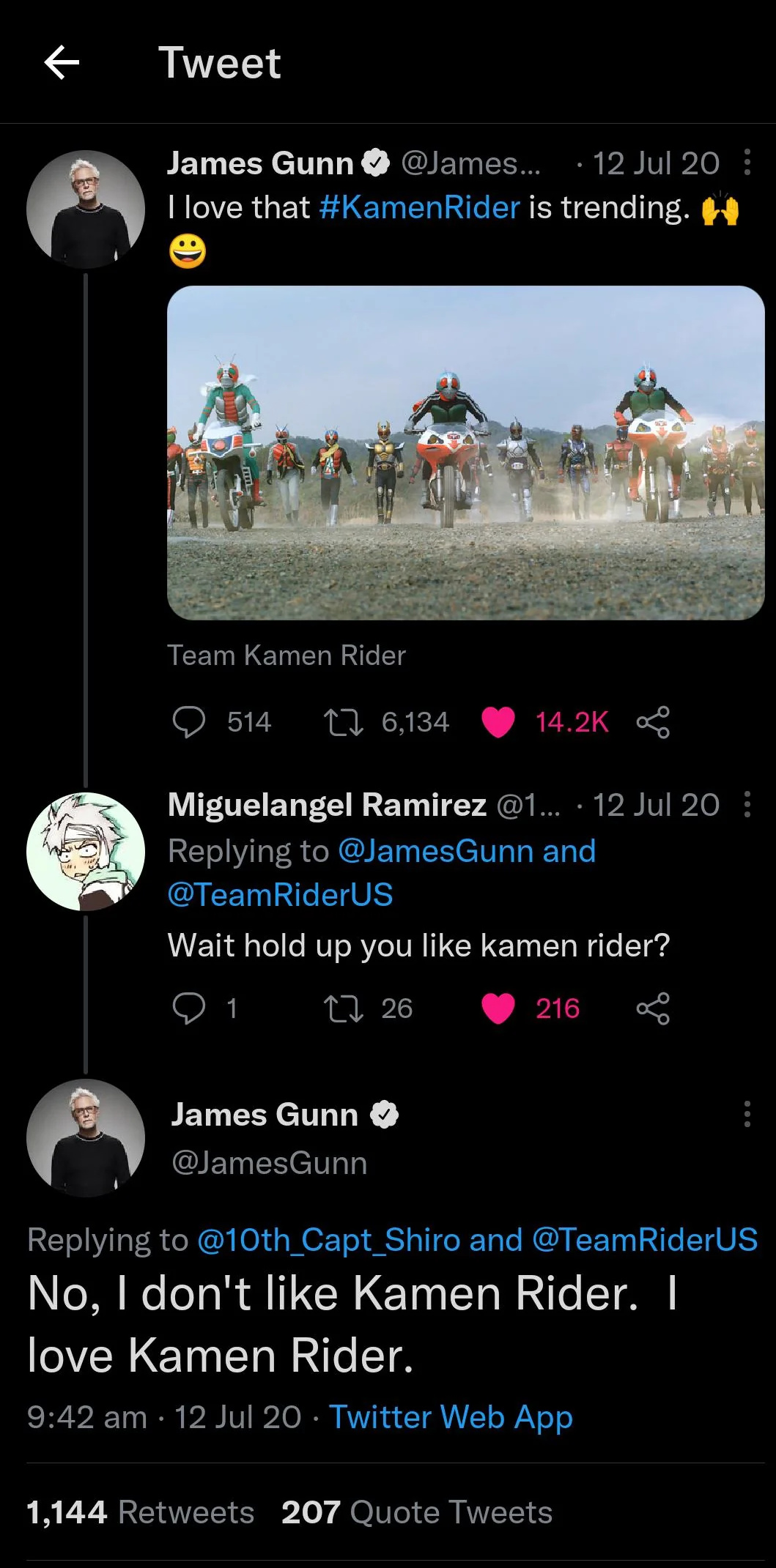
no matter how easy it is to convince yourself Kamen Rider is serious adult business - available internationally mostly through the efforts of turbo-nerds, and with some different cultural benchmarks for stuff like 'how much blood can you show on a Sunday morning kids' show' - it's important to be mindful of the fact that we're on the outside looking in. at the same time, that doesn't preclude the idea that these shows are full of charming characters, exciting action, and stories that i've found myself attached to. having a healthy relationship with media and knowing when you're not the target audience doesn't mean you can't enjoy a good story in an unexpected place. if anything, i know how much a well-crafted story can mean to a kid, because i wouldn't be here doing all this if i hadn't been inspired to think deeper about the things i watched. what shows like Adventure Time did for me, hopefully Kamen Rider has done and will continue to do for its core audience.
so, if you can keep that in mind along the way, and you're willing to jump through a few hoops to try something new, maybe consider giving Kamen Rider a chance to work its way into your heart. y'know, as a treat. after all, if it's good enough to get a nod from James Gunn, there's probably something worth checking out about this whole tokusatsu thing, yeah?