

TOKUSATSU TRADITION, AND WHERE TO START YOUR RIDER KICK-OFF
added sep.3.25
updated xxx.x.26
difficulty rating xooo
it's come up a lot in passing or in rambling diatribes about color theory, but in case you missed it, i happen to be a pretty big fan of Kamen Rider. it's an intensely varied franchise that you can approach from a ton of angles, and despite its relative obscurity outside of Japan, it's so intensely popular there that learning about it feels like kind of a Rosetta Stone for parsing all sorts of superheroic tropes in your favorite anime and manga.
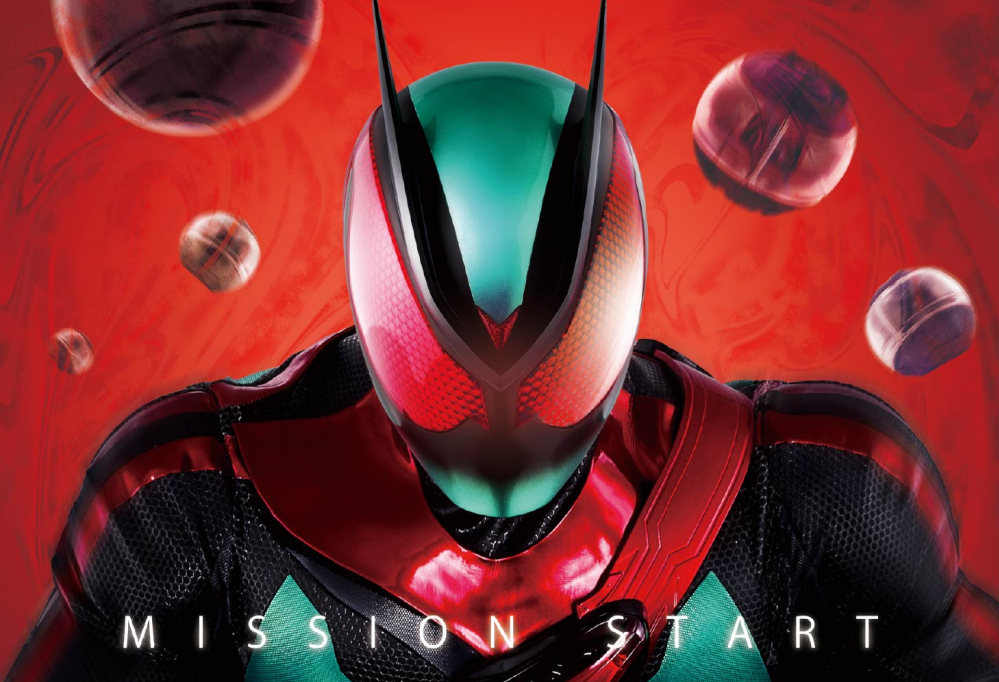
as i write this, we're less than a week away from the debut of another yearly iteration, the lucid-dreamer-turned-secret-agent Kamen Rider Zeztz. for the first time in series history, Zeztz will be officially simulcast to western audiences. even with fans having to twist Toei's arm again and again to make it happen at all, let alone be done right, it's a big leap forward, one that would have been unimaginable a few years ago. my own personal experience with Kamen Rider started from afar, appreciating its suit design and following each new release only through the lens of waiting for the next toy to drop. i've enjoyed the whole vibe of Rider for over ten years at this point, but it was only over the course of the last year that i sat down and actually watched through a season of the show for myself, thanks to my friends having glommed onto my fascination and bringing me along for the ride. now, hopefully, lots more people can have that same experience, whether that's by keeping up with Zeztz week-to-week or by seeking out the show on their own when Toei's broadcast policies prove too frustrating to untangle.
undeniably, though, Kamen Rider can be a lot to process if you haven't been inoculating yourself to its over-the-top theatrics for years. i feel like culturally, we're in the midst of a big pendulum swing towards color and camp breathing life back into superhero media, with films like James Gunn's Superman, but even that is still an 'all audiences'-type of movie, tapping into some very real and very heavy world events with the same confidence as including characters like Krypto the Superdog. Superman does not draw his power from collectible toys spouting off 15-second jingles, and the medium of his world isn't a weekly television show meant to sell toys to Japanese pre-teens. in the most sincere, least gatekeep-y way possible, i wouldn't blame anyone who walks out of a DCU movie saying "i love campy capeshit" to still bounce off of Kamen Rider's intensity.
so, consider this a crash course for the Rider-curious. i can't necessarily make you someone who's going to like Kamen Rider, or impart full encyclopedic knowledge of every show's ins and outs, but what i can do is try to give you a basic framework of the franchise's history and production, some idiosyncracies that might not be immediately obvious if you're just hopping into fan discussion for the first time, and a few personal impressions of seasons i've seen.
WHAT IS KAMEN RIDER? LIKE, WHAT'S IT ABOUT?
Kamen Rider is, on a big picture basis, a long-running franchise of tokusatsu series, originated by prolific mangaka Shotaro Ishinomori in 1971, produced by television supergiant Toei in close partnership with toymakers at Bandai. having been running on-and-off for over fifty years, the shows feature costumed superheroes, classic 'rubber suit' monsters, and a plethora of pyrotechnics, wire works, and other special effects to create larger-than-life fight sequences.
to an outside observer, it might seem like Kamen Rider is a title so broad as to be meaningless. each year brings a new season with its own largely self-contained premise; new cast, new worldbuilding, new suits, new everything, with a few loose patterns imposed by the franchise's needs as a toyline. you can hop into basically any season of Kamen Rider and watch it on its own merits without paying any thought to what came before or after, aside from some anniversary milestones and maybe a handful of standalone crossover specials.
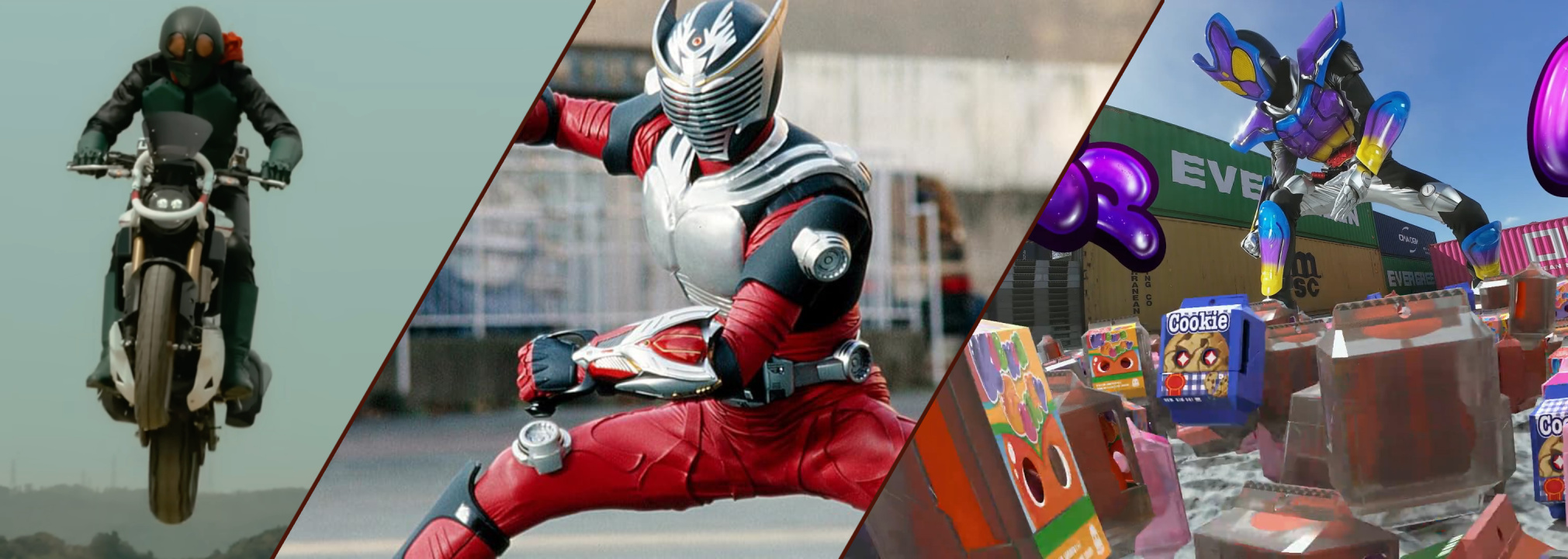
much like fellow Japanese icon/Bandai flagship/chronic re-interpreter Mobile Suit Gundam, though, even if new iterations might vary wildly, there's a core thematic underpinning dating all the way back to Kamen Rider's roots that's stuck with the show to this day. Shotaro Ishinomori was fascinated with the idea of a hero defined by tragic irony, someone who had something taken from them and had to use power granted through evil to protect the innocent. the original Kamen Rider, Takeshi Hongo, was kidnapped by fascist scientists and turned into a cyborg, stealing away his life as a promising young student while ultimately creating their own downfall. even now in the 2020s, this same foundational ideal is rethought and remixed for every new season of Kamen Rider, and while different seasons might emphasize it to different degrees, "Kamen Riders use the same power as their enemies to fight for justice" is generally applicable to any given version.
of course, there's also just the name itself. "Kamen" literally translates to "masked", and "Rider" is increasingly a bit of an oddity, carried over through years of tradition. the original Kamen Rider was an avid motorcyclist, with his iconic red-and-white Cyclone proving to be the perfect way to generate enough wind power to activate his transformation. the fact that lead actor Hiroshi Fujioka broke his leg doing his own stunts within the first dozen episodes and had to pass the mantle off to Rider #2 for almost thirty episodes was probably a bad omen for how long motorcycles could remain a core pillar of the franchise, in hindsight. Japanese road safety laws mean that nowadays, the bike is largely a formality reserved for the first handful of episodes, no matter how elaborate the workarounds get, including investing in a real-world cutting-edge hoverbike. in short, don't worry about it too much.
HOW DOES THE WHOLE TOYLINE THING FACTOR IN?
over the years, Kamen Rider has proven to be an incredibly lucrative way to sell lots of toys, and modern Rider is essentially built in tandem around its toyline in such a way where you can identify patterns year-to-year; patterns which, in turn, inform the way fans talk about and compare seasons.
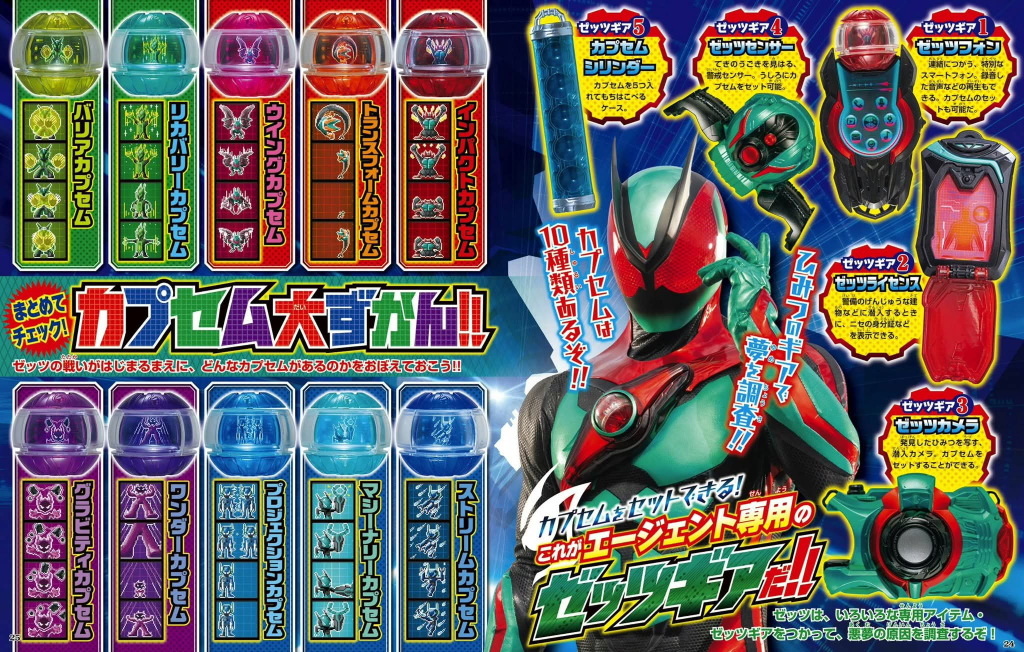
a new season of Kamen Rider generally starts around September, and right off the bat, the toys are often one of our first glimpses at what we're in store for, debuting a month or two ahead of the actual television series. this initial rollout will include things like the new protagonist's transformation equipment (almost always a belt, although Zeztz is mixing things up by wearing his cross-body style), some weaponry, a bike that's compatible with new action figures, and since around the 2010s, the all-important collectible items that work with all these other toys to produce all sorts of lights and sounds. recent collectibles have ranged from trading cards to snack-themed monsters, with 2025's new gadget being gashapon-style capsules that use a spinning core to create the optical illusion of animated pixel art.
one reason i want to put such a fine point on the toyline side of Kamen Rider - aside from the fact that you could collect the gear from the show, if you're willing to deal with importing everything from Japan - is that being savvy to how the pacing of new toys affects the pacing of the narrative is kind of taken for granted by long-time fans. you might see things like "Q1 upgrade" thrown around, and while it's not hard to connect that to the context of a character receiving a power-up in the show, the fact that it almost always happens within a specific range of dates every year is predicated on the idea that the toys are coming out at a predictable, carefully tuned cadence. even the 'Q1' in there is referring to fiscal quarters, partially as an artifact of the days when entire toy catalogs would leak every three months and often provide our first look at a new season.
once you spot this pattern - a Q1 blowout ending with an upgrade around December, an additional Rider arriving with their own gear in Q2, a final form debuting in summer as part of Q3, movie tie-in toys filling out Q4 as the show winds down to make way for a new cycle - you'll start to notice how it provides a framework for the narrative of any given season. different seasons might handle these elements more-or-less gracefully depending on the writer and how well-equipped they are to plan things out with all aspects of the show's production, but there's a remarkable consistency that then becomes the standard language die-hard fans use to contextualize the show.
I SAW SOMEONE TALKING ABOUT "SHOWA" AND "HEISEI", WHAT'S UP WITH THAT?
you mostly don't need to worry about this, but it does come up just often enough that i should probably explain it? it basically just means 'old' and 'new, but in the way things from 2007 are still new'.
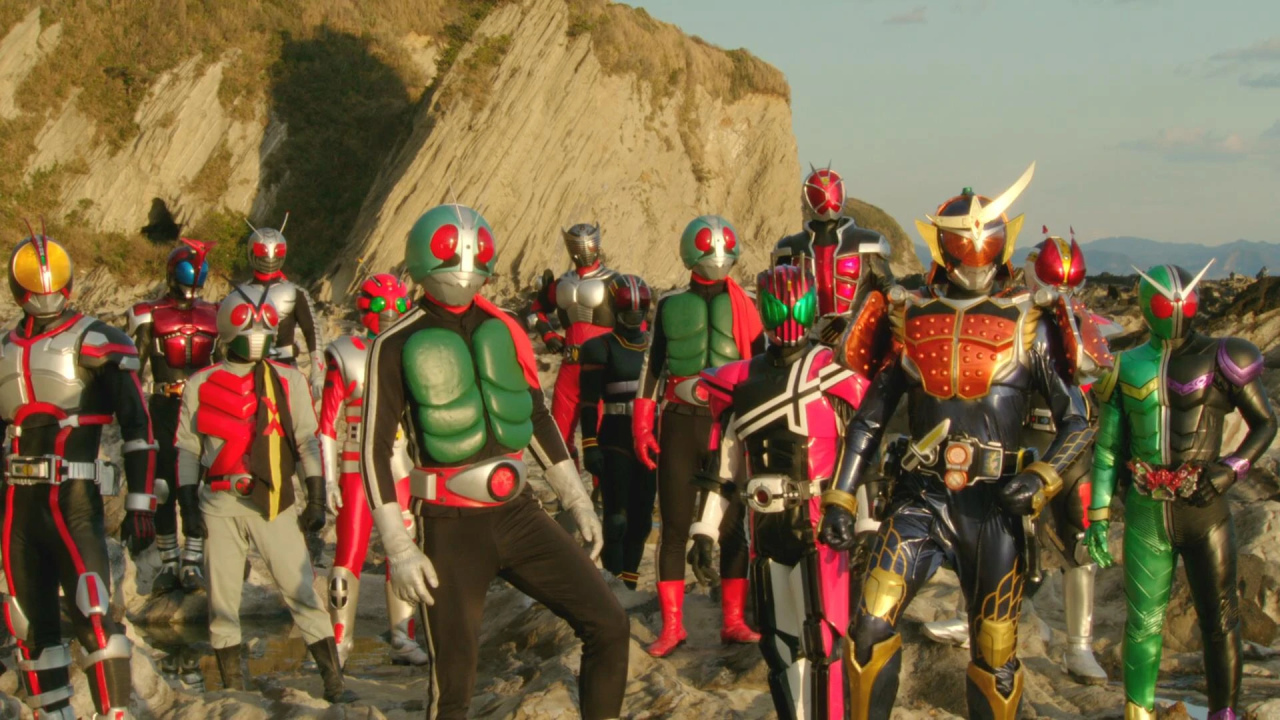
like a lot of other tokusatsu franchises such as Godzilla, Japan's imperial eras often get used as shorthand by both fans and creators to draw dividing lines between different eras of production. Kamen Rider started in the Showa era, made a comeback in the Heisei era, and has been on the air ever since, rolling directly into the current Reiwa era. as you can probably guess by me dedicating any amount of time to explaining this, it's not exactly that simple, though.
first of all, in both cases where the era changed over, Kamen Rider was still actively on the air as it happened. the literal, actually-recognized-by-the-government Heisei era kicked in about ten episodes into Black RX, the last televised Rider of the 1980s. meanwhile, in 2019, everyone knew the emperor was stepping down in advance, so Kamen Rider Zi-O got to use the start of the Reiwa era as a metatextual element to its time travel anniversary shenanigans.
more importantly for the matter of shorthand, though, when Kamen Rider evokes the Showa era, it actually means 'from 1971 to about 1994, five years deep into the Heisei era'. with the television series in cancellation limbo for the third time, Shotaro Ishinomori instead helped develop future concepts as one-off movies, with Kamen Rider J being the last of the three to release before Ishinomori passed away in 1998. as a result, the line gets nudged over to include the three theatrical riders of the 1990s, and instead serves as a distinction between Shotaro Ishinomori's creations and later adaptations.
Heisei and Reiwa proved to be a much cleaner, less dramatic split, with Kamen Rider having stayed on the air consectutively the whole way; 25 years straight, as of this writing. all the same people still produce the show, so the distinction is really just technical. you might see people bring up 'Phase 2' or 'Neo'-Heisei, referring to everything between W and Zi-O, but as far as i can tell, that's just a fan-created subcategory that's caught on. those shows do happen to cover the period where you really see collectible devices start taking off as a core component that spans the entire toyline, so it's not an entirely useless term. you're just less likely to see that level of granularity when it comes to things like big crossovers or the usually-toy-exclusive 'Legend Rider' items that pay homage to past seasons.
WHERE CAN I WATCH KAMEN RIDER, AND WHY IS IT SO GODDAMN HARD?
this is where we start getting into why Kamen Rider has really struggled to find a foothold outside of Japan! as i've already gone over, international releases are very rare, and simulcasts are literally just now becoming an option in 2025. the situation is improving, but it's still a little sparse and scattered.
the retro anime juggernauts over at Discotek Media have started covering the Showa era over the last few years, with V3, X, Amazon, Stronger, Black, and Black RX all seeing full Blu-Ray releases since 2023. this seems to be a bit of a secondary partnership, though, as Shout! Studios has generally received a more diverse catalog and had more leeway with how they distribute the show in America. through Shout!, you can watch the 1971 original series, Heisei fan-favorites Kuuga and Ryuki, and recent Reiwa releases Zero-One and Geats. these are all available as Blu-Ray box sets, or through a variety of weird streaming releases, showing up on places like Tubi, the world's fakest real website.
of the major streaming outlets that get any Kamen Rider, Amazon Prime is probably the 'realest'; some of the Shout! releases are available there without any secondary subscriptions needed, and it's also home to two pieces of spinoff media. Kamen Rider Black Sun is a modern 'prestige' miniseries that i'd describe as "Black by way of Logan", while Hideaki Anno's Shin Kamen Rider fits into the director's franchise-hopping run of tokusatsu reboots. if you have Crunchyroll, you can also check out Fuuto PI, an anime following on the events of Kamen Rider W... which you can't go watch.
perhaps the strangest of these first steps into distributing Kamen Rider in the west - and, coincidentally, the most useful for the purposes of this article - is Toei Tokusatsu World Official. originally launched as a companion to a full-fledged Toei Tokusatsu Fan Club service in Japan, this YouTube channel mostly hosts a variety of classic series from the 20th century, such as the Metal Heroes franchise. what you might really find interesting, though, is that they also have the first two episodes of almost every season of Kamen Rider. for free! with official English subtitles! official English subtitles that, according to the description, were subsidized by the Ministry of Economy, Trade and Industry of Japan, for some reason!
Toei Tokusatsu World Official is, to be blunt about it, underbaked. i haven't scrubbed through every available episode for myself, but there's consistent reports that as uploads continued, subtitle timing and synchronization got sloppier, and there's often video quality issues, especially with a few Kamen Rider movies thrown onto the pile at 480p. it's hard to find any reliable reporting on the whole initiative, but fandom hearsay seems to be that the intention might've been that fans could use YouTube's community-driven subtitling tools to carry on Toei's work... only for Google to discontinue that feature and for Toei to stop uploading altogether. no matter why it exists, this weird little YouTube channel, for all its flaws, is somewhat invaluable, in the sense that it's the only outlet Toei has ever given western audiences to actually try a sampling platter of Kamen Rider's fifty-year history. if nothing else, it's probably the most low-commitment way to just throw a season on and see if it's grabbing you.
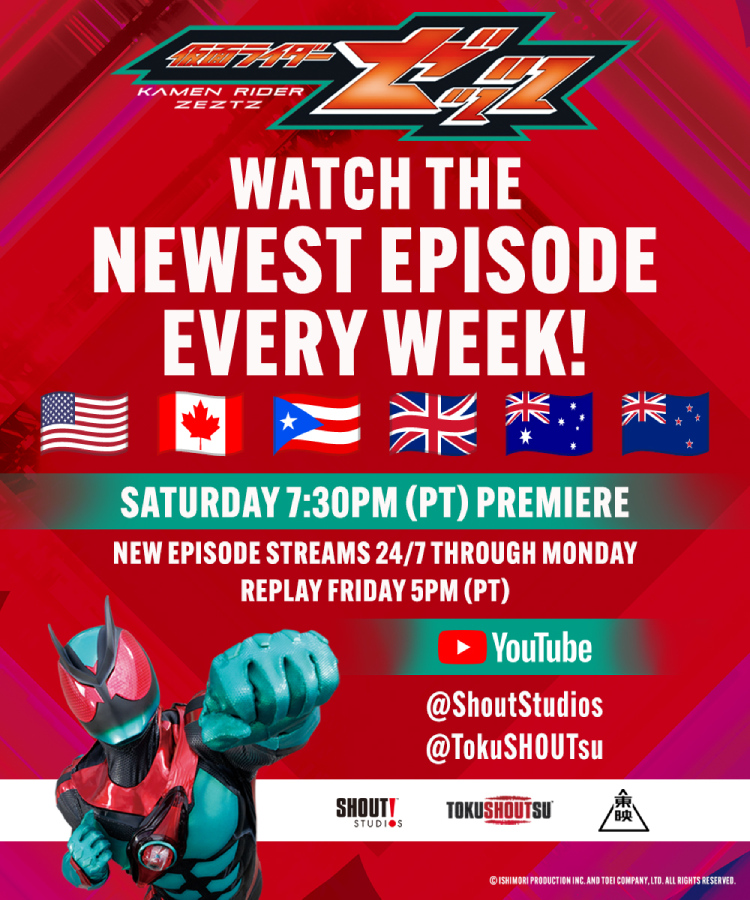
and then there's our newest Rider, our cutting-edge foray into the world of simulcasting. even with mere days left until the big premiere, details seemed to be in flux about how this would go down, and changes were thrown around last-minute that forced me to rewrite this whole little section. for international viewers, Kamen Rider Zeztz will be heading straight to YouTube through Shout! Studios, albeit with a few key caveats that might be a little offputting to new fans. the primary mode of distribution will be through livestreams, starting on Saturday nights right alongside the Japanese debut and looping the new episode 24 hours a day through Monday. if you happen to miss these broadcasts, there'll be some type of repeat on Friday before the cycle begins again, but Shout! only plans to release the series for on-demand viewing in batches of five or so episodes. believe it or not, even this strange arrangement is the better version of how things could have gone, with the initial announcement explicitly stating there'd be no VODs for people who might want to start following Zeztz later in its run. hopefully, this bodes well for Toei giving an honest effort to stay attuned to international fans? we'll see!
with all that broken down, it's also worth mentioning that fansubs exist. fansubs exist! they're out there! it's a long and storied artform! the people who've been doing it the best for the longest have always been very clear about their willingness to back off any time Toei wants to step up and sell Kamen Rider directly to English-speaking audiences, and they've generally followed through on that promise where relevant. i'll just leave it at that, for this website's sake. fansubs sure do exist. sometimes they even do all sorts of wild text rendering magic to make the belt jingles pop. they sure are out there, somewhere.
there's plenty of other weird little franchise tidbits i could dive into all day, but i think this seems like a good enough place to call it. hopefully this gives you some sense of what Kamen Rider's all about, the unique circumstances of its production, and maybe it can help chip away at some nerd talk that might seem a little impenetrable if you're just jumping in for the first time.
now comes the fun part, where i get to step out of informational mode and get all opinionated! as someone who's now seen multiple seasons of Kamen Rider, i want to give each one i've watched its own time to shine, and go over why you might want to check them out for yourself. basic beginner plot run-down, lay out some of that year's toyetic fun factor and how it might influence the design work and narrative, and make my own case for what makes it stand out from the rest. sound good? good!
KAMEN RIDER DEN-O
2007 - 2008THE BACK-OF-THE-BOX BEATS
Ryotaro Nogami, the world's unluckiest guy, discovers a mysterious train pass that puts him onboard the time-traveing DenLiner. the wish-granting Imagin are tampering with the past, but a few key defectors help Ryotaro become Kamen Rider Den-O, overriding his meek personality with their own quirks and ticks, whether that means turning him into a violent punk or a suave charmer. as they begin to form unlikely friendships and protect people's cherished memories, the arrival of new interlopers throughout the flow of history reveals deeper machinations that hit far closer to home for Ryotaro.
THE NEW TOYS
of the seasons i'll be going over here, Den-O is by far the least toyetic; it was still a few years out from those major collectible devices that plug and play with every part of a Rider's equipment. that's not to say that it doesn't have its own merchandise to push, of course. each of Den-O's Imagin allies grants a unique form, loosely themed around Japanese folklore, with its own configuration of the modular DenGasher weapon. the real thing you can tell the show really wants you to buy, though, is the DenLiner itself. while it mostly serves as a home base for the Imagin, every once in a while you'll see it start deploying increasingly absurd weaponry in massive CGI battles with foes too big for Den-O to handle alone, and the debut of new Riders and upgrades often means a new addition to the train set.
WHY WATCH THIS ONE?
what Den-O lacks in dense narrative, it makes up for five times over with character. it's not hard at all to see why this show in particular saw such an extended impact on Kamen Rider, both in a literal sense with its years of follow-up movies and by way of becoming sort of a template for future Rider casts. it's also not hard to see why its lead actor, Takeru Satoh, became such an astonishingly big star that it's hard to even book him for a return anymore, as he effortlessly layers the Imagin's larger-than-life personalities onto his own performance at the drop of a hat. Den-O can feel a little directionless as you wait for the story to kick into high gear, but when it wants to hit hard, it can go to some pretty surprising lengths to twist the knife and make you feel for the characters. if you're looking for a funny, over-the-top show with a sort of gag manga appeal to its ensemble cast, and you don't mind realizing you're starting to care too much about these dudes' emotions halfway in, check out Kamen Rider Den-O.
WAR FOR CYBERTRON: SIEGE SIDESWIPE
deluxe class // released 2019 // entry added apr.29.24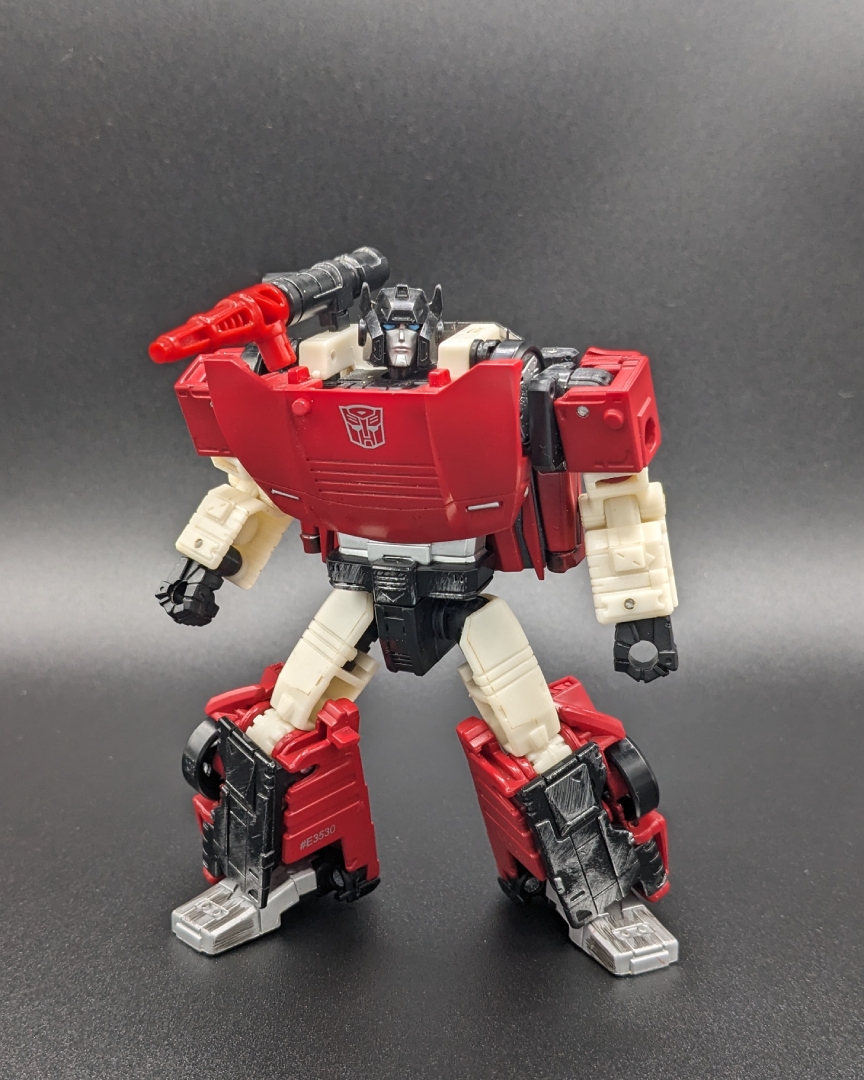
as the first figure i picked up from the Siege line, Sideswipe is definitely one of the first toys that comes to mind when i'm thinking of broad examples of the modern era of Transformers. after the ups and downs of the Prime Wars era, it seemed like Hasbro were coming out swinging with a bit of a soft restart on CHUG, standardizing a new approach with smaller, denser figures, emphasizing articulation, and finding a way to incorporate heavy play potential without intrusive gimmicks just by leaning hard into the mix-and-match appeal of the standard 5mm port and post. i don't have much attachment to Sideswipe as a specific character (he sat out several of my favorite pieces of Transformers media, after all), but i can't deny that he's a solid standard slab of Autobot and an excellent representation of the War for Cybertron design ethos.
in robot mode, Sideswipe wears the classic 80s 'robot with a car hood chest' body-type with surprising finesse. he's got a bit of a backpack, but it's wide and flat, so it doesn't interfere at all with his excellent balance and posability. he's done up in one of the nicest matte finishes i've ever seen on a Hasbro figure, and aside from the hints of Cybertronian detailing and the battle damage scuffing that would spread across the entire Siege line, he looks remarkably close to his on-screen appearances. he's an absolute joy to handle thanks to a robust set of nice tight universal joints, and he's definitely got a particularly solid feel, much more than his predecessors and even some of his WfC contemporaries. conversely, he's a little light on accessories, but even his classic G1 shoulder cannon has been given a fun split in the middle to play into the whole customizable weapon schtick Siege was all about.
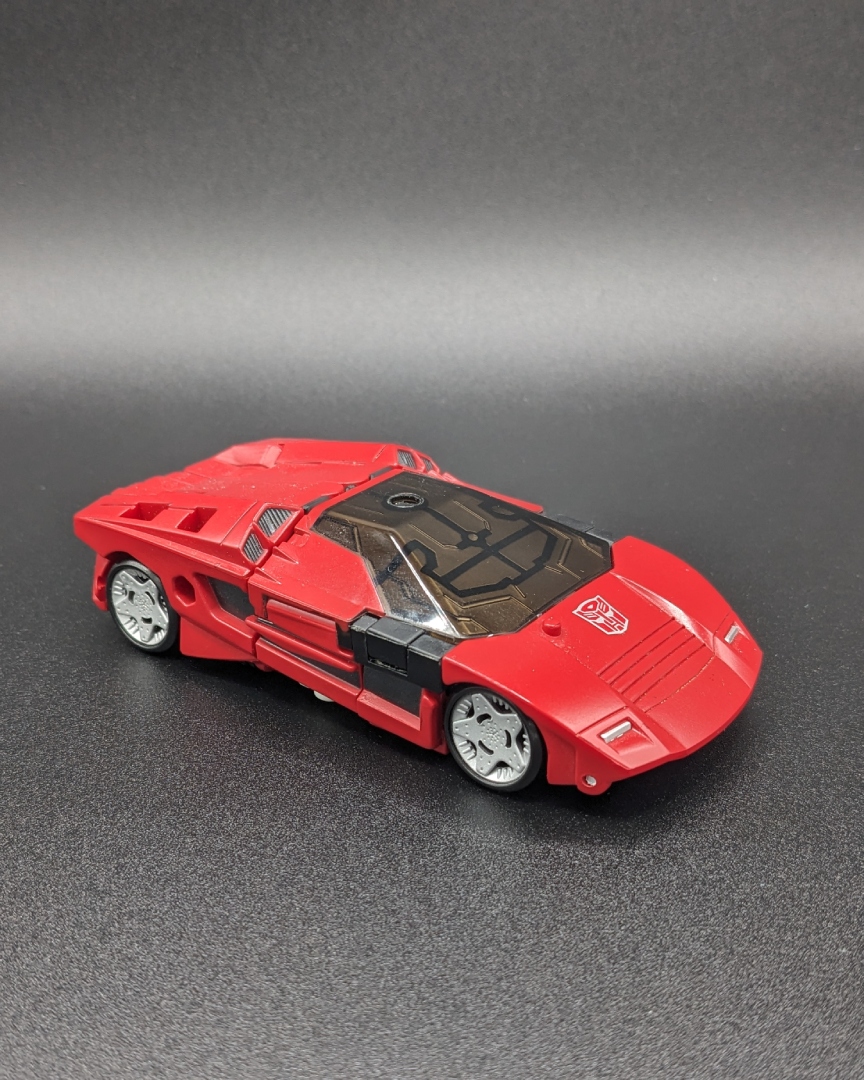
transformation is quick and inoffensive - no big surprises here, but solidly executed. easy to just fidget with, and no troublesome parts that don't want to tab together. Sideswipe converts into what is ostensibly a Cybertronian racecar, but honestly? the real-world Lamborghini he traditionally assumes as his disguise is already pretty distinctive for an Earth mode, so he mostly looks like a real-world concept car that could be in some billionaire's collection right now. he gets some nice sci-fi detailing underneath the extra-wide windshield, and the designers definitely seem to have had some fun exaggerating the massive flared shape of what i think are supposed to be air intakes (i'm not a car person), but for the most part, he's definitely a pretty standard race car shape. no big play features, nothing to really nitpick, either - just a well-done take on a well-trodden archetypical Transformer design.
WAR FOR CYBERTRON: SIEGE IRONHIDE
deluxe class // released 2019 // entry added apr.29.24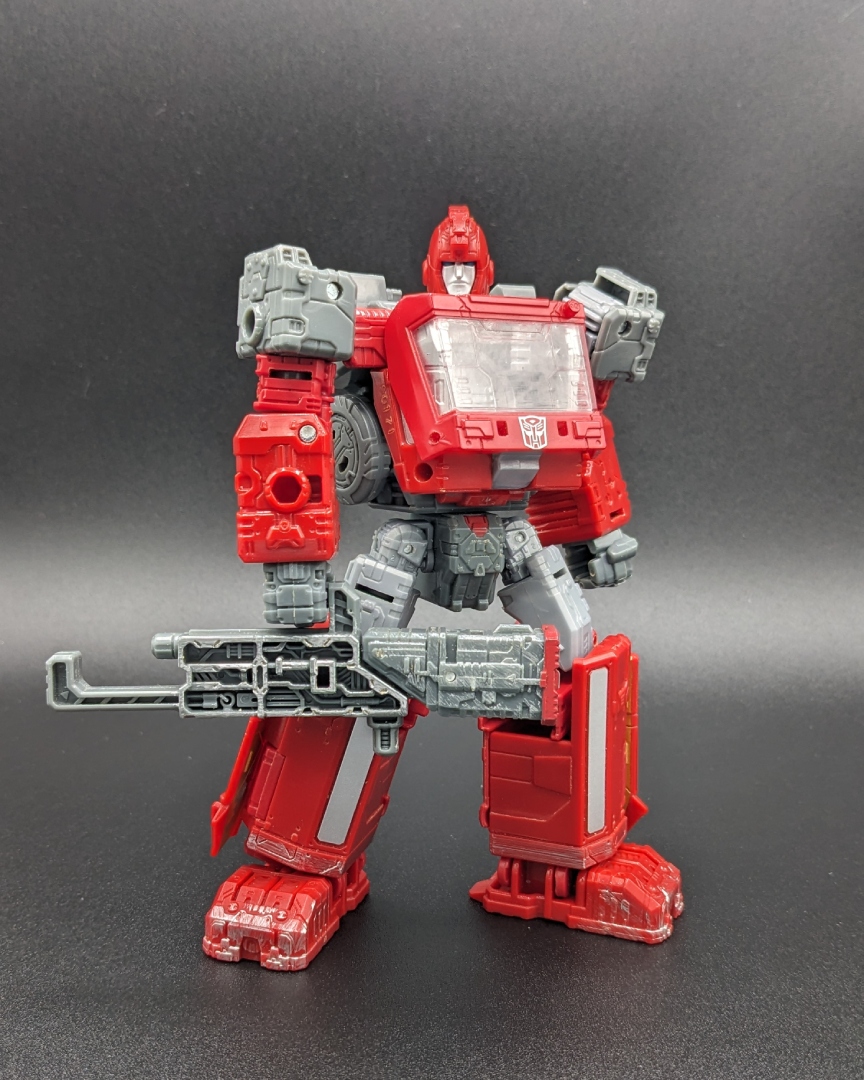
i remember feeling very strongly that i had to make sure i got my hands on Siege Ironhide. for starters, he's pretty remarkably big for a Deluxe-class, so i guess it seemed like a good value to put some heft into the Autobot side of my collection? on a broader, more 'nerd minutia' level, though, Ironhide is just one of those characters who's had a pretty infamously rough history when it comes to his toys, whether it's having a droopy head or having no head at all. even shortly after the release of this toy, that quest for the perfect Ironhide has continued, whether it was Earthrise coming around the very next year to try hiding his lumpy sci-fi bod in an Earth minivan cloak or Studio Series deciding that the solution was to step him up a pricepoint just to get the engineering benefits of a $35 toy.
enough about other Ironhides, though, how is this one? definitely an odd one. he's not quite the full-blown G1 cartoon extravaganza that a lot of Siege was dedicated to, but he's also quite firmly too much of a big clunky spaceman to be the sort of mid-2000s 'what if G1 but the vehicles were newer' reinterpretation i enjoy. he's doing a bit of his own thing, and i'm here for it. you definitely feel that imposing stature, for better or for worse - he easily stands well above similarly priced toys of his era, although that comes at the cost of feeling a little more hollow across the board. if i had to sum him up, i'd say he feels very weird and maybe even a little flimsy in-hand, but when you find the right pose, it all comes together and he's just full of personality and presence. it certainly helps that he has one of the best accessories in all of Siege, with his excellently titled 'Doomblast Forge Launcher' pulling double duty as a missile launcher and hammer, pictured here on HYPERFIXT with its superfluous but greatly appreciated carry handle.
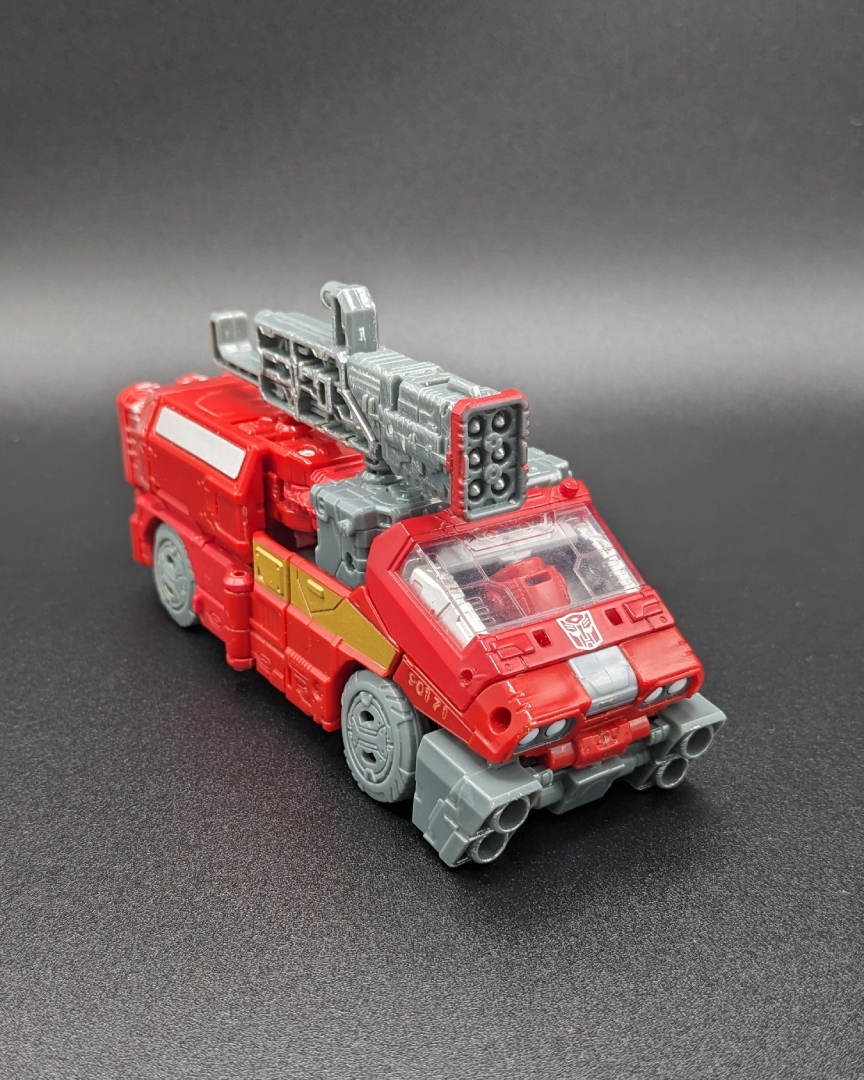
vehicle mode? i mean, yeah, sure, he's got one, in the form of this king-sized candy bar of a space truck. his transformation starts off strong, with the entire front-facing half of his torso turntabling around, but the legs feel very simple and his feet just kind of end up sticking out of the back. i definitely don't hate it, and i give it props for at least committing pretty hard to Siege's Cybertronian aesthetic instead of just doing a blatant Earth mode reskin, but i feel like it's missing something, although maybe that's just because Earthrise literally does give you a giant shield to wrap around the top to complete the classic G1 silhouette. the gray-on-gray wheels definitely don't do him any favors for that low-impact feel, and while you can almost eke out a play feature by folding his leg shelves down to mount the weapon into, doing so leaves his entire uninterrupted robot arms laid bare on the roof, so it feels decidedly unintentional. points for thematic flair and being fittingly thick for the character, but he's missing that secret sauce that'd really excite me.
WAR FOR CYBERTRON: SIEGE GALAXY UPGRADE OPTIMUS PRIME
leader class // released 2019 // entry added apr.29.24read more about this figure here!
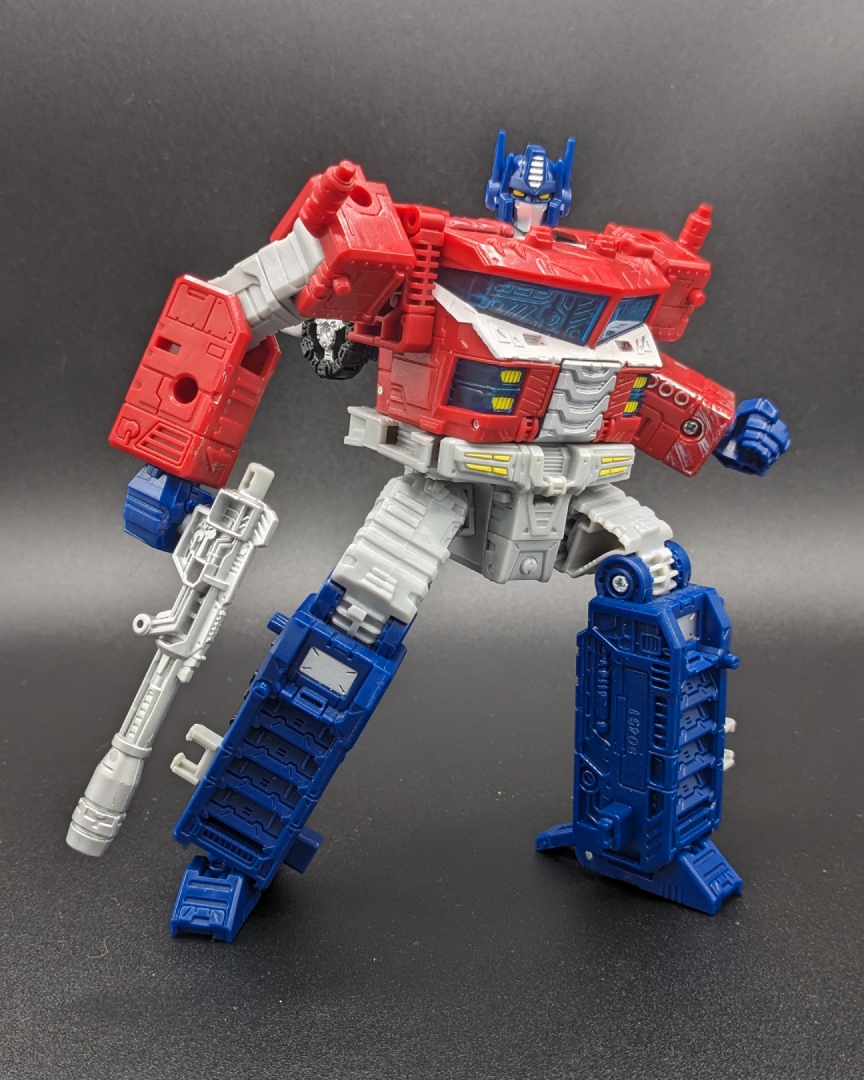
while Siege seemed mostly concerned with going back to square one and building the foundations for a definitive G1 cartoon roster, plenty of modern figures inevitably end up with a second lease on life through extensive retooling, and War for Cybertron came out swinging on this front. by taking advantage of Ultra Magnus's 'guy inside another guy' design, Hasbro managed to give the figure an entirely different feel by leaving the core robot intact and dressing him up in some 'Optimus circa 2005' armor. nowadays, in a world where Hasbro seems like they're ready to cash in on zoomer nostalgia and redo just about the entire Unicron Trilogy from scratch, there's something a little quaint about Galaxy Upgrade Optimus Prime. back in 2019, though, this was pretty much the first time Hasbro was paying tribute to the toys i personally grew up on, and i still have a lot of fondness for this weird half-step of a design.
without his new set of big boy parts, GUOP's inner robot mode takes on a distinctly un-Cybertron-ish vibe, winding up as the chunkiest Optimus we've seen in quite some time. it's not perfect, but it's at least servicable, and i do find something charming about the way it harkens back to the character's roots, without any of the heroic proportioning we see today. you're definitely not here for the little guy, though - he's a formality, a leftover from when this toy was a distinctly different guy.
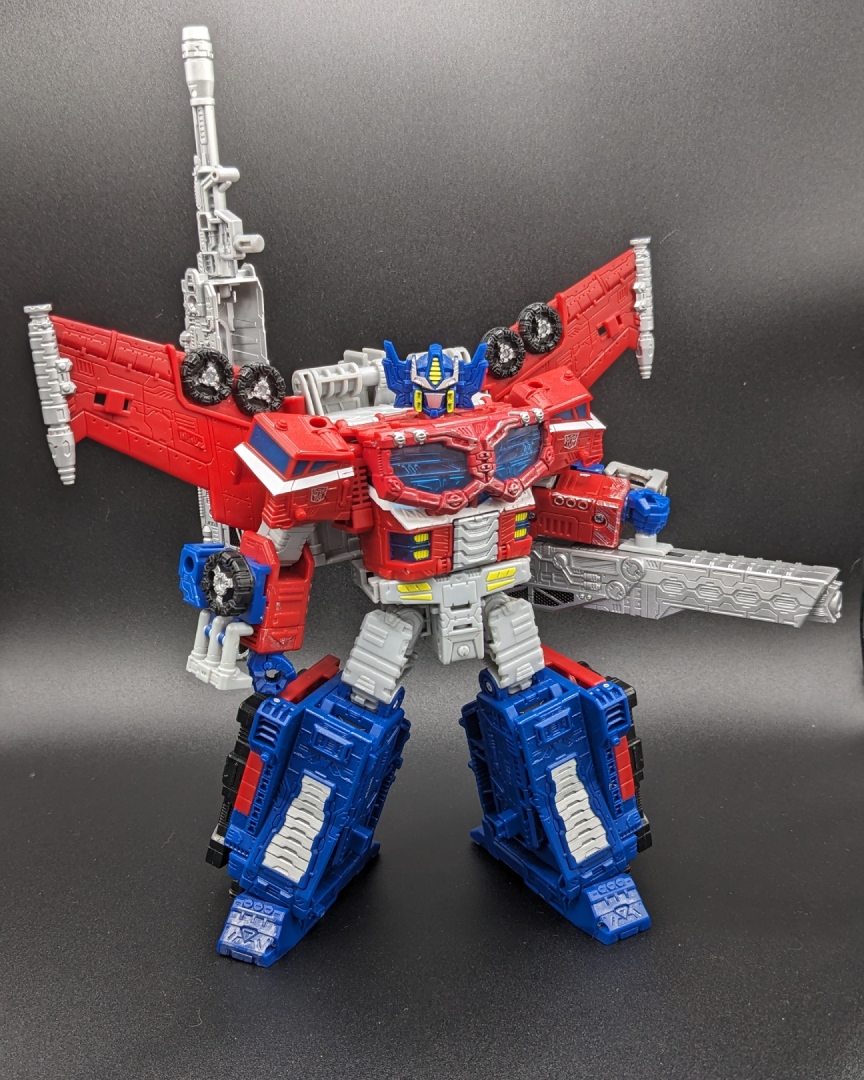
once he's armored up, Optimus definitely isn't a perfect likeness for his 2005 counterpart, but he's trying his best and i have to admit, i'm too charmed by it to really stay mad about the inaccuracies. yes, he doesn't have his long boots, and he's way fatter in the middle, and he could use a little more paint, but those wings? the massive under-the-arm slung cannons? the greebly trapezoid space windows on his chest? he might not be my Optimus, no, but he's taken a few very important lessons and gone way further than i think anyone would reasonably expect a retool to. his wingspan alone gives him a pretty imposing presence, which is only aided by his adjustable artillery, and having the benefits of modern articulation like a hip swivel and ankle tilts really brings out this design's innate flair for dramatic heroic poses.
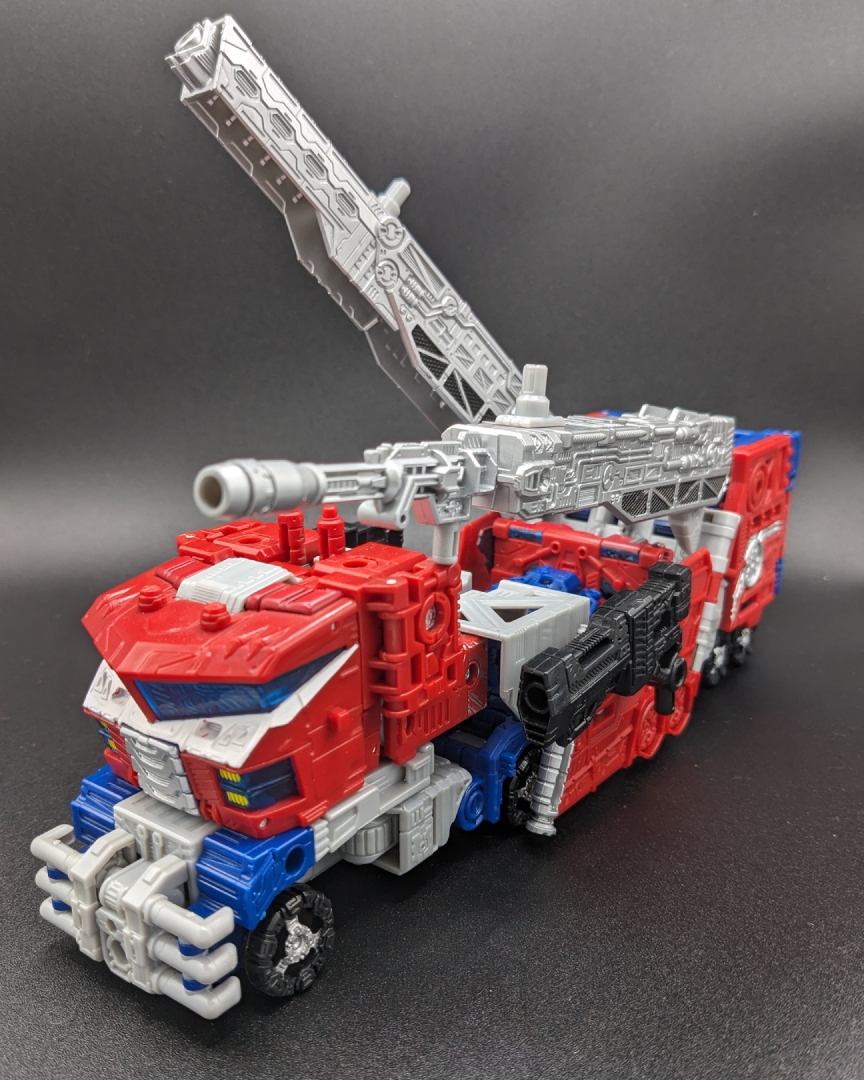
unfortunately, i would say that while the designers did an excellent job on the robot mode, you definitely start to see how janky this whole endeavor is when you look at the vehicle mode. without the trailer, Optimus's truck mode just feels underbaked with his arms hanging off the back, but attaching the armor feels finicky and requires a little more force than i'm comfortable applying to the plastics, and it mostly ends up creating more problems. the cannons certainly look nice, and at the right angle you can overlook some flaws, but the whole thing feels hollow and strange, and the lack of paint on his new faux-wheels really hurts the facade. it's not enough to diminish the things i like about the figure, but it is, at best, easily the worst part of a decent package. at worst, it might be enough to make a person start wondering if there's any shot of getting a better Cybertron revitalization down the road.
LEGACY: UNITED ANIMATED UNIVERSE OPTIMUS PRIME
voyager class // released 2024 // entry added apr.29.24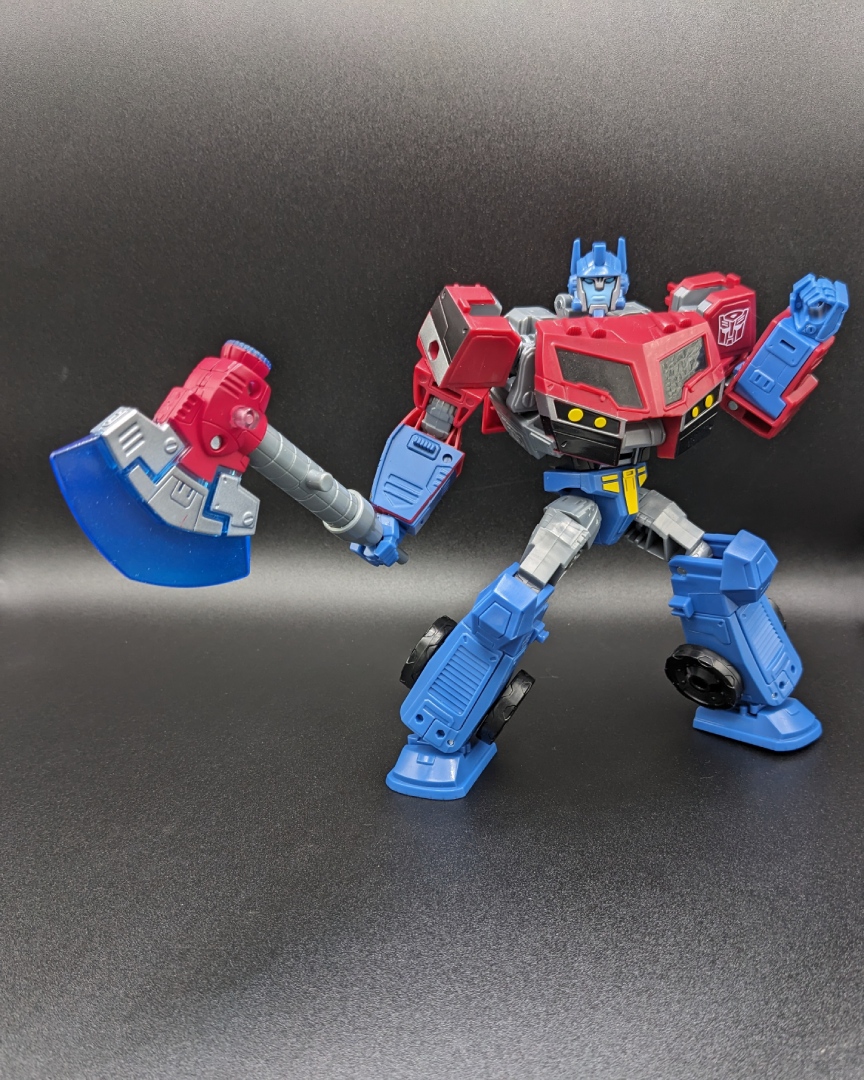
coming in right alongside Bumblebee as part of the first wave for 2024, Legacy: United Animated Universe Optimus Prime - yes, i know the name's ridiculous but they keep making these in such a way where i will have to keep labeling them like that - kind of wound up with some big shoes to fill. obviously, when you're opening up Pandora's box and digging through 40 years of Transformers history, there's going to be a lot of Optimus, but so far, they'd all wound up as pretty major collection centerpieces. Animated Optimus has to come in and get us back to basics at a relatively modest pricepoint while also setting the stage for the actual brand anniversary we've all been waiting two years for. and i won't even try to be all coy and wait until the end of this entry to make my point, he totally does all that, he's so cool and so Animated and so Optimus and i love him a whole bunch! let's get into why!
Animated's take on Optimus Prime might be one of the things that really sets it apart as a chapter of Transformers history and makes me love it so much - you think of this character archetype and think of something like harsh stoicism or the dad jokes of G1, but this Optimus has a more youthful energy to him, having to prove himself as a hero after ending up in a dead-end job cleaning asteroids. he's maybe gotten a touch beefier while making the jump into Legacy, but this whole figure does a fantastic job capturing that personality, from his crisp head sculpt right down to having noticeably softer tones of red and blue compared to contemporary figures of other Optimuses. he also maintains a surprising amount of Derrick J. Wyatt's iconic shape language while also posing up a storm, and he doesn't really have any bad angles. if i have to say anything about him is less than perfect, i guess sometimes his axe's extending handle feels a little janky to work with, but that's already above and beyond for a modern Transformers accessory and that transparent blue blade looks just as good no matter how you display it.
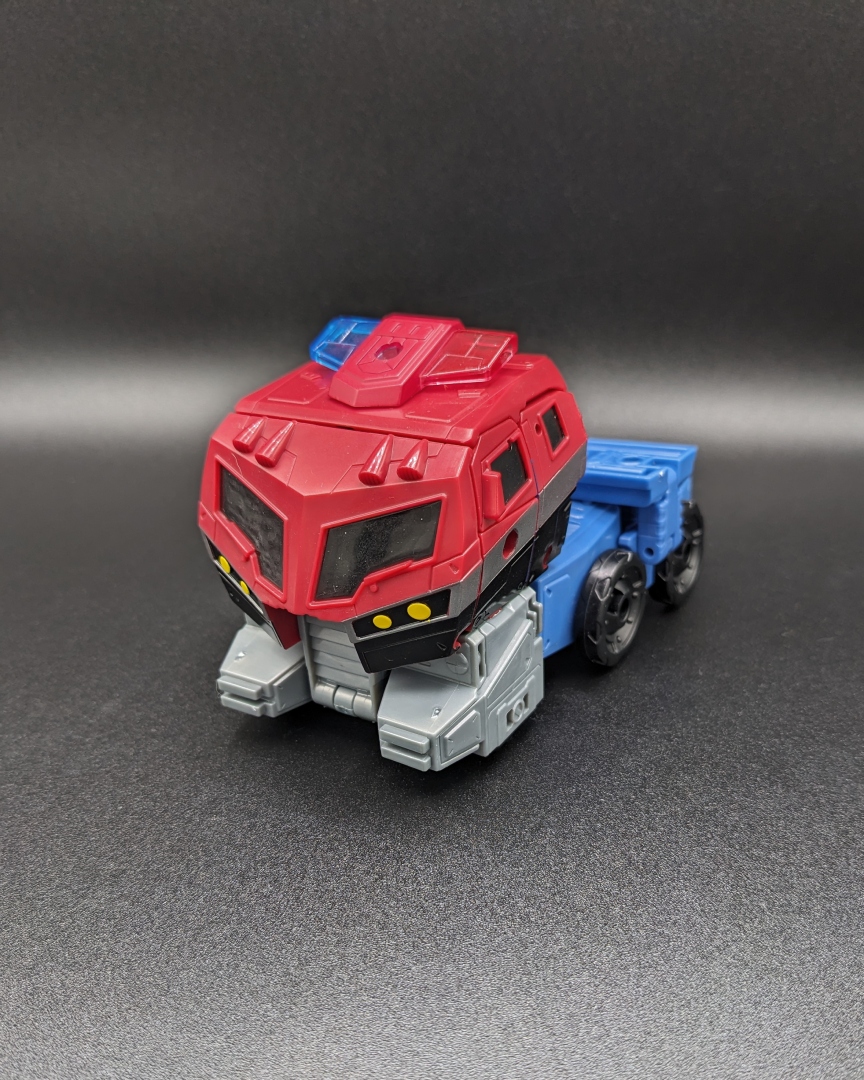
as if being a really good robot wasn't enough, Animated Optimus also has a surprisingly involved transformation - complex, but still welcoming and intuitive enough for play. i was a little intimidated picking him back up for a photoshoot, but everything moves in a way that just feels right for the pieces to do. he follows the same basic formula as most Optimus figures, with his arms and torso forming the cab, but they twist and turn in such delightful ways, and it's really cool how the sharp superheroic angles straighten out into this tall glass of water. the rounded boots on the back feel maybe a touch clunky, but it's hard to complain too much when they nailed the shaping of this vehicle so well, right down to hiding its frontmost wheels to create the 'floating' look of the animation model. i know for a fact there's already people trying to figure out how to sweeten the deal even more by recreating his endgame jet-trailer, and i get it, but even if this is all the Animated Optimus we end up getting this decade, it'll still feel like the total package to me.
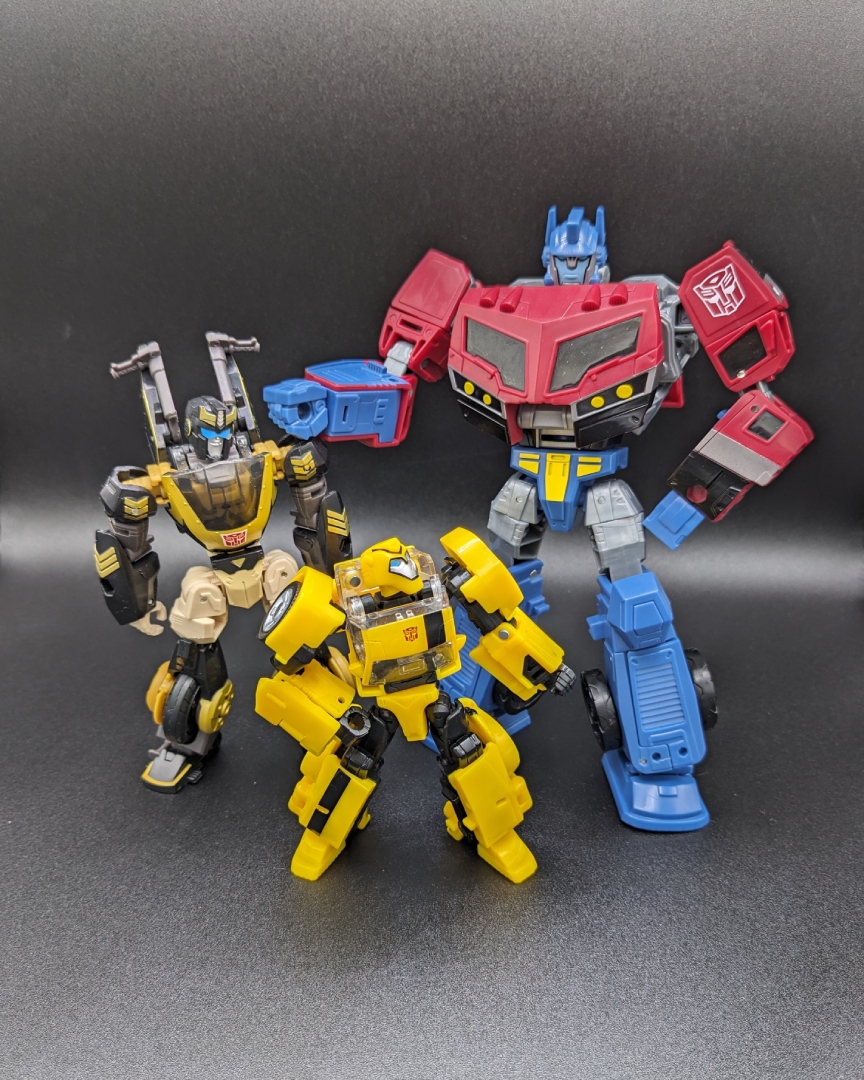
for now, though, as of 2024, it seems like this might be all the Animated we see at all for a hot minute. the arcane scrying eyes of Wal-Mart product codes tell us that there don't seem to be any major new additions to the Ark crew coming in 2025, as the toyline pivots into yet another new three-year cycle. you could maybe make the argument that Legacy's take on Bulkhead could slot in here, but... different show, and also not even especially styled to look like anything other than G1, and you'd still be down a Ratchet. i'm still holding out hope for some kind of weird miracle or a big comeback around the corner, but even if these three Autobots wind up being all we get, it's been a real treat to see Animated get its due like this. if you have to pick up just one? absolutely Optimus - he's the best toy, he displays the nicest, he's the main character. if you have the luxury of all three? go for it, they go great together, and you never know when Hasbro'll get that craving to complete the set. besides, we need to convince them that a Commander class Lugnut is a really good idea somehow, right? baby steps.
Lorem ipsum dolor sit amet, consectetur adipiscing elit. Morbi mollis sit amet mauris eu convallis. Cras eget libero finibus velit congue sodales. Ut scelerisque mauris rhoncus tellus volutpat mattis. Quisque fringilla eros nec iaculis iaculis. Pellentesque in blandit leo. Proin bibendum tincidunt varius. Duis molestie nec sapien quis elementum. Nam nec posuere magna. In sed maximus justo, sed blandit lectus.
Lorem ipsum dolor sit amet, consectetur adipiscing elit. Morbi mollis sit amet mauris eu convallis. Cras eget libero finibus velit congue sodales. Ut scelerisque mauris rhoncus tellus volutpat mattis. Quisque fringilla eros nec iaculis iaculis. Pellentesque in blandit leo. Proin bibendum tincidunt varius. Duis molestie nec sapien quis elementum. Nam nec posuere magna. In sed maximus justo, sed blandit lectus.